The Friends of the Wildflower Garden Inc.
Plants of the Eloise Butler Wildflower Garden
The oldest public wildflower garden in the United States

Common Name
White False Indigo (White Wild Indigo, Large-leaved Wild Indigo)
Scientific Name
Baptisia alba (L.) Vent. var. macrophylla - also listed as B. lactea (Raf.) Thieret
Plant Family
Pea (Fabaceae)
Garden Location
Upland
Prime Season
Early Summer
White False Indigo is an erect native perennial forb growing from 3 to 6 feet high on mostly smooth stems with ascending branches in the upper part of the plant. Shoots of early spring resemble and may be mistaken for Asparagus.
The leaves are trifoliate (sometimes with 5 leaflets) with each leaflet oblanceolate (longer than wide, broadest above the middle, tapering to the tip) to ovate, with smooth margins, bluntly pointed to rounded tips, narrowed bases, the leaflets not stalked, but the leaf is on a stalk that has a pair of small stipules at the base of the stalk. Leaves dry to a black color.
The inflorescence is a tall raceme of stalked flowers atop the stem and held high above the upper leaves. There are small bracts below the inflorescence.
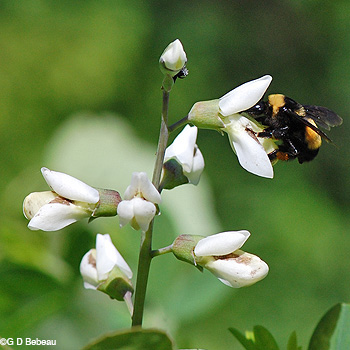
The flowers are perfect, 1/2 to 3/4 inch long, and are on short stalks with white corollas. The green calyx is tubular with 5 pointed lobes while the corolla forms a pea-type flower consisting of 5 petals where the larger upper banner petal turns upward and reflexes backward toward the calyx. There are two lateral petals projecting forward and two keel petals between them that house and hide the reproductive parts, which consist of 10 stamens with yellow anthers and a single style. Large insects such as bumblebees can force open the keel petals where they touch together to reach the pollen contained inside.
Seed: Fertile flowers produce an oblong inflated seed pod with the calyx firmly attached at one end and the remains of the style at the other. The pod is green at first then turning dark brown at maturity. The pod contains a row of brown kidney shaped seeds which are loose in the pod when mature. The pod splits open at maturity to release the seeds by wind or bird dispersion. As the stems and racemes become somewhat woody, pods frequently over-winter. Seeds can be germinated in the spring after cold storage. They need a short period of cold stratification plus scarification but scarification can be avoided in seeds are sown outside in the autumn. The pod is shorter but fatter than than of B. australis.
Habitat: False White Indigo grows from a rhizomatous root system with a taproot sending up one to several stems. It forms clumps rather than spreading colonies. Being a prairie plant it needs full sun, accepts wet-mesic to dry conditions in a variety of soils. It is not as well adapted to the home garden as False Blue Indigo but once established, makes a fine specimen and transplanting should be avoided.
Names: The true Indigo, from whose leaves is made blue indigo dye, is Indigofera tinctoria with pink to violet flowers, hence these Baptisia's with blue or white flowers are termed "false." The genus name Baptisia is from the Greek word bapto, meaning 'to dye.' A dye can be made from the false plant but it is inferior. The species name, alba, is Latin for "white." The variety macrophylla means 'large leaved' as this species has larger leaves than other variety Baptisia alba var. alba.
The author names for the plant classification are: First to classify was '(L.)' which refers to Carl Linnaeus (1707-1778), Swedish botanist and the developer of the binomial nomenclature of modern taxonomy. His work was amended by ‘Vent.’ which is for Étienne Pierre Ventenat (1757-1808), French botanist who published several works about plants in French gardens including the rare plants of Malmaison. French gardens grew many species imported from the New World. For more detail on the confusion in scientific names see the note at the bottom of this page.
Comparisons: A similar plant is False Blue Indigo, B. australis, but there the plant is shorter, not branched, the flowers blue, the leaves smaller and the pod longer but thinner.
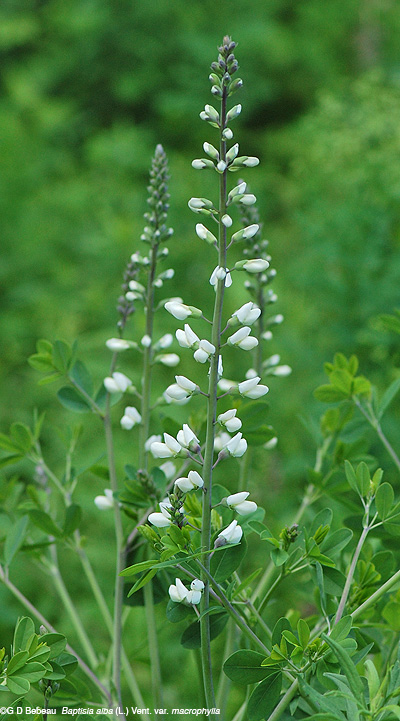

Above: White False Indigo in bloom at the end of June. Note the ascending branches of the stems. 2nd photo - The fully ripened seed pods in October, prior to seed release.
Below: 1st photo - The green calyx is short with 5 pointed lobes. 2nd photo - shows the typical flower arrangement with a large backward flexing banner petal, deeply notched in the center so as to look like two petals; the two forward projecting laterals enclose the two keel petals.


Below: 1st photo - This flower has been fertilized and the green ovary is expanding into a seed capsule- stamens still visible. 2nd photo - Large bees can force open the petals to reach the pollen.

Below: 1st photo - The stalked leaf usually has 3 leaflets, not stalked, with a pair of small stipules at the base where it joins the stem. 2nd photo - Roots form a taproot with small rhizomes.


Below: 1st photo - The seed pods of late July after the flowers are finished and - 2nd photo- at the end of August they are turning dark as seeds ripen. 3rd photo- Seeds in the pod.


Below: The new stem shoots resemble and may be mistaken for asparagus.

Notes: Eloise Butler's records show that she planted seeds of White False Indigo on October 15, 1925 and that she obtained plants of this species on September 11, 1927, but that they were "three poor roots" from a source in Iowa. Martha Crone planted the species in 1933 and 1945 and sowed seeds in 1944 and 1953. The plant is native to Minnesota in the SE. It's range in the U.S. is the central Mississippi and Ohio River valleys, west as far as Texas and Nebraska.
Special Concern: In the wild White False Indigo is listed on the Minnesota DNR's "Special Concern" list. The only other species of Baptisia native to Minnesota is the Plains Wild Indigo, B. bracteata, which is also on the DNR Special Concern List.
Naming issues: There is some bit of confusion in the botanical world as to what species name should be assigned to White False Indigo. Two plants were formerly assigned the name of Baptisia lactea - False White Indigo (Large-leaved Wild Indigo) with the name of B. lactea (Raf.) Thieret, and White Wild Indigo with the name B. lactea (Raf.) Thieret var. obovata. Some authorities, including the University of Minnesota Herbarium and USDA, have moved both species into B. alba with Large-leaved Wild Indigo being named B. alba (L.) Vent var. macrophylla and White Wild Indigo being named B. alba (L.) Vent var. alba. Only the former is found in Minnesota, the latter is found along the Gulf Coast. Some authorities have kept the older names - the Minnesota DNR's 2019 survey list still used the old name. So meanwhile you will find the same species listed with two primary species names. A much older synonym for False White Indigo is B. leucantha. which is how Eloise Butler listed it and is how Martha Crone listed it on her 1951 Garden census.
Return to -- Site Plan/Archive Index --or-- List of Common Plant Names -- or -- List of Scientific Names -- or --Home Page - - - Back to top.
References: Plant characteristics are generally from sources 1A, 32, W2, W3, W7 & W8 plus others as specifically applied. Distribution principally from W1, W2 and 28C. Planting history generally from 1, 4 & 4a. Other sources by specific reference. See Reference List for details.
 Identification booklet for most of the flowering forbs and small flowering shrubs of the Eloise Butler Wildflower Garden. Details Here.
©2015
Friends of the Wildflower Garden, Inc. Text and photos are by G D Bebeau unless otherwise credited. "www.friendsofeloisebutler.org"
051923