The Friends of the Wildflower Garden, Inc.
Plants of the Eloise Butler Wildflower Garden
The oldest public wildflower garden in the United States
Common Name
Wild Quinine (American Feverfew, Eastern Feverfew)
Scientific Name
Parthenium integrifolium L.
Plant Family
Aster (Asteraceae)
Garden Location
Upland
Prime Season
Early Summer to Late Summer Flowering
Wild Quinine is a native erect long-lived perennial forb growing from 1 to 4 feet in height on a stout stem rising from a basal rosette of leaves. The stem is green with some fine hair on the upper portion which part also has a slight zigzag shape. It is usually unbranched below the floral array.
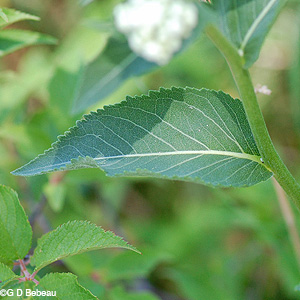
Leaves: The upper stem leaves are alternate, toothed, lance shaped and appear stalkless as they touch the stem on the upper part, small stalks on the lower stem. The lower basal leaves are elliptical, up to 12 inches long and 5 inches wide with long stalks and rough surfaces. The central rib of all leaves is quite prominent. Leaf surfaces may have very short stiff hair and are gland dotted.
The floral array consists of dense flat-topped clusters (corymbs), each cluster on its own stalk and grouped at the top of the plant. Axillary clusters can arise from the upper leaf axils.
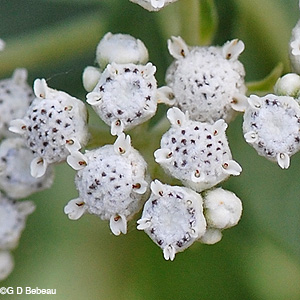
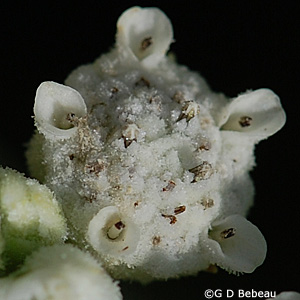
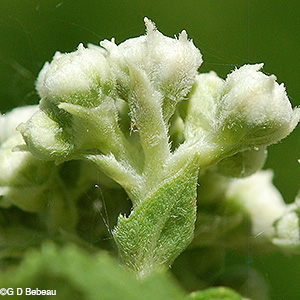
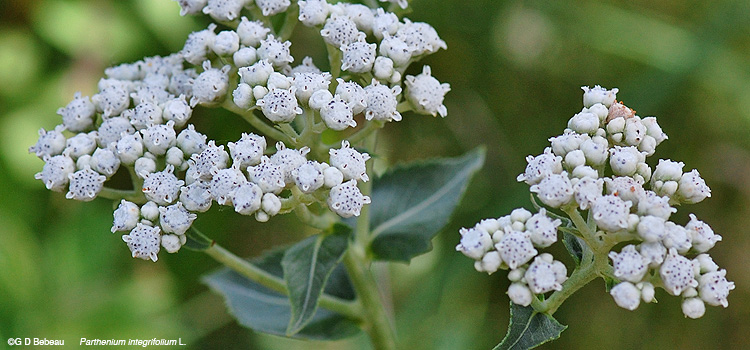
The individual flowerheads are very small composites, about 1/3 inch wide, stalked, each flower composed of 5 very small white fertile pistillate (female) ray florets widely spaced around the circumference of the central disc which is composed of numerous (15 to 35) disc florets. The female ray florets have dark tipped bifurcated styles. The disc florets have a white corolla 5-lobed at the throat. These are functionally staminate only, hence infertile, with 5 stamens which have distinct filaments but with the dark anthers tight together. The flower head is hemisphere shaped with 2 rows of floral bracts (phyllaries) around the outside of the head, the outer row oblong with appressed hairs, the inner row broader in shape, usually 5 phyllaries in each row. Flower stalks also have fine hair. The flowers have a light medicinal fragrance and can be used as cut flowers.
Fruit: Fertilized ray florets develop into a dry achene-like seeds called cypselae; there are without any attached pappus, but with several short awns (pappus-like outgrowths) although the awns may sometimes be lacking. The cypselae are more or less obovoid in shape and 3 to 4 mm long. They will be wind distributed by wind shaking of the stem.
Habitat: Wild Quinine grows best in full sun and in a wide range of soils as far north as Zone 3 in mesic to dry conditions. Due to it's rare status in our area, buy only nursery grown stock not plants from the wild. It grows from a tuberous root whose rhizomes can vegetatively spread the plant. It has no serious pest problems and grows well from seeds which can be planted in the fall, or in the spring if given 60 days of cold stratification first.
Names: The genus name Parthenium, comes from the Greek parthenos meaning "virgin" which refers to the central infertile disc florets which, contrary to rule, are usually fertile in Aster Family plants. The species name integrifolium, is from the Latin for "entire or uncut leaves". The author name for the plant classification from 1753 - 'L.' is for Carl Linnaeus (1707-1778), Swedish botanist and the developer of the binomial nomenclature of modern taxonomy. As to the common names, see the 'medicinal use' section at the page bottom. In years past two other botanical names were used with this species but are not accepted today: Parthenium auriculatum and P. hispidum.
Comparisons: The flower head with the 5 small widely spaced fertile ray florets around a central disc of infertile florets is distinctive to the genus Parthenium and somewhat unique in the Asteraceae where the disc florets are usually fertile. No other species of Parthenium is found in Minnesota.
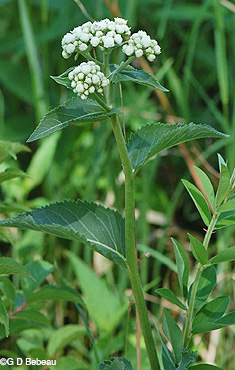
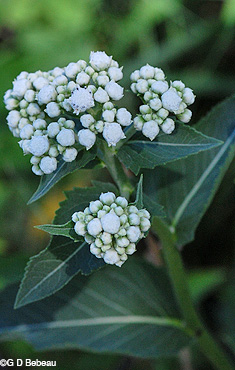
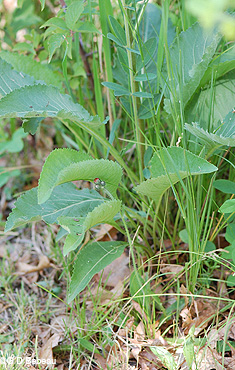
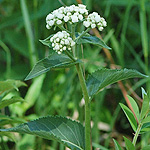
Above: 1st & 2nd photos - The maturing flower clusters of mid to late July. 3rd photo - The long basal leaves on long stalks.
Below: 1st photo - a portion of flower cluster. 2nd photo - Detail of a single flower showing the position of the five fertile ray florets surrounding the infertile disc florets. The anthers of the disc floret stamens are tight together and appear dark.
Below: 1st photo - The flower head has 2 rows of phyllaries, the outer row oblong with appressed hairs; the flower stalks and the leaf-like bracts have fine hair. 2nd photo - The upper leaves appear stalkless as they touch the stem.
Notes: The date of appearance of Wild Quinine in the Garden is unclear. It was not listed on Martha Crone's 1951 Garden census, but was present by the time of the 1986 census so either Martha Crone or Ken Avery must have planted it. Cary George noted planting it in 1998. This plant is quite rare in Minnesota as the state is at the extreme NW corner of its range. It is known to be native (that is, collected in the wild) to only four counties in SE Minnesota - Fillmore, Houston, Mower and Dodge. This is the only species of the genus found in Minnesota. It does grow well in the metro area in prairie type soils. There are 7 species of Parthenium found in North America.
Endangered: Wild Quinine is listed as "endangered" by the Minnesota DNR and is on the "threatened" list in Wisconsin. It's native range is generally east of the Mississippi River although it has been introduced into many western states. The Minnesota DNR reports that very little of the original range is left as agriculture has converted most of the original habitat to cropland. The DNR has acquired two abandoned railroad rights of way where the species was growing and designated those strips as a Scientific and Natural Area.
Medicinal Use: Native Americans of the SE are known to have used the plant for medicinal purposes, particularly for treating burns, using the leaves, which contain tannins, as a poultice. In modern times the National Institute of Health has identified Parthenolide, a chemical obtained from Wild Quinine, as a potential anti-inflammatory active agent and has the potential for the treatment of cancer cachexia (Phytomedicine. 2013 Aug 15). The powdered root also produces a bitter substance which was explained in King's American Dispensatory, 1898. The flowering tops were used to make an infusion that was said to be equal to 20 grains of sulphate of quinine.
These former uses for Wild Quinine help explain the common name and the alternate common names. It was used in place of quinine, and as a tonic. Calling it 'feverfew' is also a reference to a European plant used for similar purposes - Feverfew, Tanacetum parthenium.
Return to -- Site Plan/Archive Index --or-- List of Common Plant Names -- or -- List of Scientific Names -- or --Home Page - - - Back to top.
References: Plant characteristics are generally from sources 1A, 32, W2, W3, W7 & W8 plus others as specifically applied. Distribution principally from W1, W2 and 28C. Planting history generally from 1, 4 & 4a. Other sources by specific reference. See Reference List for details.
 Identification booklet for most of the flowering forbs and small flowering shrubs of the Eloise Butler Wildflower Garden. Details Here.
©2013
Friends of the Wildflower Garden, Inc. Text and photos are by G. D. Bebeau unless otherwise credited. "www.friendsofeloisebutler.org"
072922