
Friends of the Wildflower Garden
Baby Songbirds Have Hardworking Parents
by Tammy Mercer
Years ago when I was learning to identify birds by their songs, I remember hearing the “yank-yank-yank” of of a white-breasted nuthatch. The bird sounded distressed, and I found it clinging to a tree trunk and calling frantically. Soon another nuthatch landed beside it, stuffed a fat caterpillar into its mouth, and the noise stopped briefly. When the second bird took off, the first one “yanked” even louder and followed its parent to the next tree for more food.
Summer is when the familiar bird songs change and we begin to hear peeping and begging sounds in the woods and meadows. If we’re lucky, we might come upon a young bird on its first foray beyond the nest. Ducklings swimming with their parents are some of the first youngsters to be seen. Like wild turkeys, shorebirds and all waterfowl, ducklings are precocial. This means they hatch out of their eggs covered in downy feathers and with their eyes open. By the time their feathers are dry they are ready to follow their parents from the nest in search of food. Precocial chicks are able to feed themselves with little or no help, but it will be two months or so before they can fly.
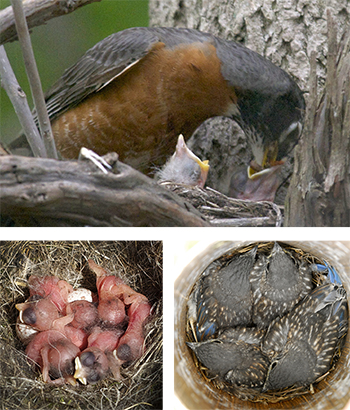
On the other hand, songbirds, like chickadees, robins, finches and blue jays, have altricial young. Their chicks hatch with few if any feathers and with their eyes closed. They are very weak and can barely hold up their heads. They are completely dependent on their parents and will remain in the nest for about two to three weeks. For the first few days, one of the parents must keep the nestlings warm. The other parent must provide a constant supply of protein-rich food for the family. As the chicks’ feathers fill out, both parents can leave the nest and forage for increasing supplies of insects to feed their young, especially fat caterpillars, spiders and other invertebrates. As an example, a robin might make 100 feeding visits to its nest each day.
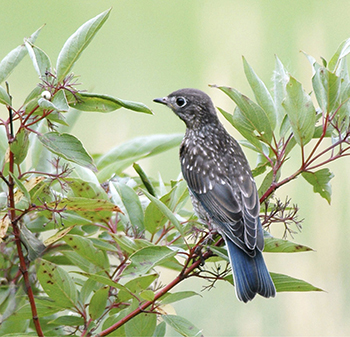
There is great competition among nestlings. At the slightest hint of movement approaching the nest, they open their little beaks wide and make begging sounds. They wing their siblings out of the way to get the next caterpillar. As they grow stronger and larger, the nest becomes crowded and the nestlings noisier. Near the end of the nestling phase, chicks in tree cavities or bird houses will climb up to the entrance hole to be the first in line for feeding. Chicks in a stick nest cling to the edge of the nest to exercise their wings and those in trees may climb out on branches. When they have grown enough to leave the nest and fly, they are called fledglings. Nearly as big as their parents, fledglings may be colored just like the parents or have subtler coloring to help hide from predators.
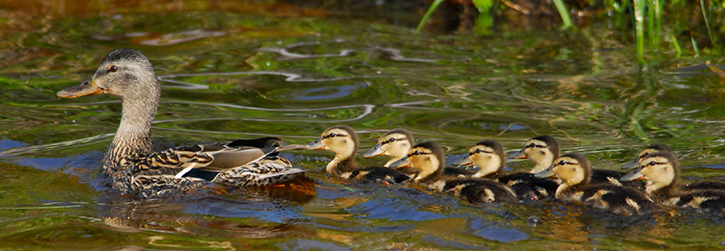
DUCKLINGS are some of the first baby birds seen in the breeding season. Photo - Jim Williams
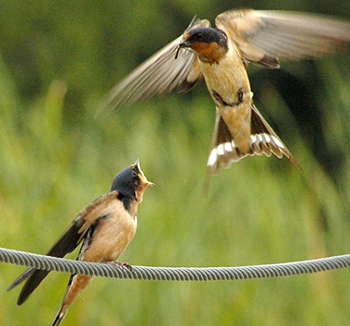
The first flight can be dangerous for newly fledged birds. Landing is especially tricky, and may require several attempts before the first awkward success. Fledglings often end up on the ground where they are vulnerable to predators like house cats. Newly fledged chicks keep up their begging calls to be sure their parents will find them. Their parents bring them food wherever they land and try to protect them from predators as best they can. While the adults forage, fledglings exercise their wings, practice short flights and landings, and explore the world with their beaks, discovering what may or may not be edible. When they have mastered flight and landings, they begin to chase their parents around, begging incessantly. They eventually start watching their parents hunt and learn to hunt for themselves. In just a few more weeks they will be on their own.
Walking through the Garden and South Wirth Park in summer, watch for adult birds carrying food and listen for the soft peeping of nestlings and the not-so-soft begging of older chicks. Look for the clumsy antics of the fledglings and listen for the alarm calls of the parents when, as curious birders, we get too close.
EARLY BIRDERS
Join the Early Birders any Saturday at 7:30 a.m. for a walk around the Garden as we identify birds by sight, sound and behavior. Our group of new and experienced birders meets April through October to watch birds in migration and throughout the breeding season. Bring binoculars!
25 Birds Commonly Seen in the Garden During Breeding Season
❀ Wood Duck
❀ Mallard
❀ Cooper’s Hawk
❀ Great Horned Owl
❀ Ruby-throated Hummingbird
❀ Red-bellied Woodpecker
❀ Downy Woodpecker
❀ Hairy Woodpecker
❀ Pileated Woodpecker
❀ Eastern Wood Pewee
❀ Great Crested Flycatcher
❀ Red-eyed Vireo
❀ Blue Jay
❀ Black-capped Chickadee
❀ White-breasted Nuthatch
❀ House Wren
❀ Blue-gray Gnatcatcher
❀ American Robin
❀ Gray Catbird
❀ Scarlet Tanager
❀ Northern Cardinal
❀ Indigo Bunting
❀ Brown-headed Cowbird
❀ Baltimore Oriole
❀ American Goldfinch
Ed. note: Short, informative essays on bird biology and behavior, including nestling, fledgling and parenting behavior and diet and foraging practices, can be found on a website maintained by Stanford University, http://web.stanford.edu/group/stanfordbirds/text/uessays/essays.html
Tammy Mercer is a Minneapolis Park Board staff member and Garden naturalist and currently leads the Early Birders walk.
This article was originally published in The Fringed Gentian™, Vol 66 no 2, 2018.