Friends of the Wildflower Garden
The Ovenbird and the Wisdom of Wild Space
by Karen Kopacz
As tree buds began to burgeon in the spring at Eloise Butler Wildflower Garden, did you notice a spirited, slightly-larger-than-average warbler called the ovenbird (Seiurus aurocapilla)?
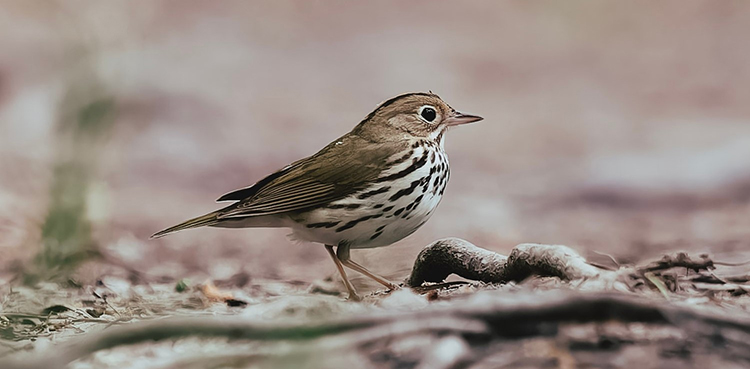
Above: The Ovenbird - photo Jordan Ryskamp
Since they are typically heard before they are seen, they are commonly identified by a volume-building “teacher-teacher-TEAcher-TEACHER-tea” call. Over the last 100 years, they have occasionally been observed at the Garden during early and mid-May after migrating from Mexico, Central America, Florida, and the Caribbean.
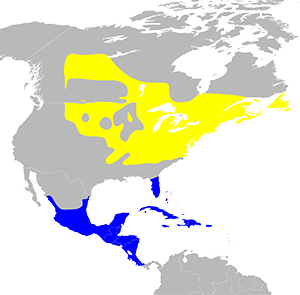
Winter - blue
Summer - yellow
The ovenbird is olive-brown with a white-breast that is streaked with dark “brush marks.” Their crowns are tinted orange and decorated with two dark stripes that extend from the nostril area of the beak and make an arc above each eye. Those who are able to observe an ovenbird in close proximity may also notice two distinctive dark stripes mirrored below the eyes down either side of the throat.
They have an odd walk for a songbird, similar to the strut of a chicken—and for this quality they are sometimes called the walking warbler. Although their color allows them to blend into their woody habitat, I have seen ovenbirds demonstrate this walk while foraging for nest materials in woodlands dense with pine, maple, and birch, with very little regard for me if I am sitting quietly.
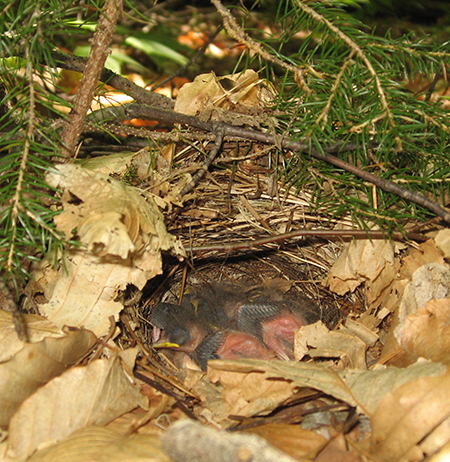
Areas of mature, closed-canopy maple-basswood or dry deciduous-coniferous forest mix are essential habitat for their breeding and nesting. They favor nesting sites where the forest floor is covered with fallen leaves and ground vegetation like asters, ferns, and clubmoss. Weaving together leaves, twigs, grass, plant stems, or bark, the female builds a domed ground nest that resembles a clay oven. The nest may be lined with animal hair or fine roots, then covered with a layer of leaves and twigs.
Robert Frost captured the Ovenbirds’ predilection for uninterrupted forest habitat in his 1916 poem The Oven-Bird with the turn of phrase “a mid-summer and a mid-wood bird.” Because ovenbirds are sensitive to forest fragmentation from agriculture and urban development, their presence in the Wildflower Garden may be attributed to its proximity within the greater woodland area of Theodore Wirth Park. This natural corridor is very slight in range due to its urban setting, but apparently provides enough closed-canopy for the ovenbird, either as a nesting site or as suitable passage for migration.
During migration, the ovenbird avoids human-made reforestation that it is not dense enough to provide cover from predators. Regenerating forest is also important habitat for these wood warblers, presumably because sapling thickets provide fledglings with protection from their raptorial adversaries.
The ovenbird is listed as a species of least concern, but loss of forest habitat is cited as one of the contributing factors to its decline over decades. Research associated with this bird underlines the importance of biological corridors, biodiversity, and preserving or rewilding large expanses of natural forestland. Symbolically, perhaps the Ovenbird carries in its song what it is really trying to teach us…the wisdom of wild spaces. ❖
Karen Kopacz is an artist, designer, who recently completed the Big Woods, Big Rivers Master Naturalist program.
Karen Kopacz is an artist, designer, who recently completed the Big Woods, Big Rivers Master Naturalist program. This article was originally published in The Fringed Gentian™ in summer 2023. Photos with a “CC” credit are used for educational purposes under Creative Commons license. Learn about this at https://creativecommons.org/share-your-work/cclicenses/