
Friends of the Wildflower Garden
Eloise Butler Wildflower Garden and Bird Sanctuary
Part I - Great Horned Owls in the Garden
by Rod Miller
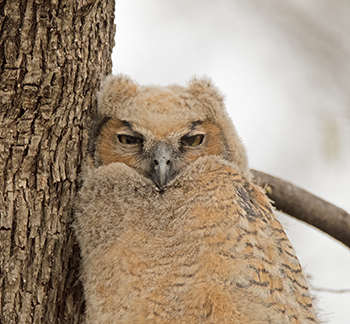
In the cold of winter, new life begins in the nest of Great Horned Owls right in the backyard of Eloise Butler Wildflower Garden and Bird Sanctuary. A family of owls has been observed at the Garden for many years. Many in the nearby Bryn Mawr neighborhood report hearing the owls from the Garden parking lot when walking in the woods or right outside their bedroom windows. It’s most likely you will hear the four to five hoots of the male owl “hoo-h’HOO-hoo-hoo” at dawn and dusk before you see him. A higher pitched voice with a few more syllables is the female. She’s also about 30% larger than the male. The owls are frequently heard and seen on the footpath surrounded by White Pine and Spruce trees just east of the Garden. Neighbors also report hearing owls near The Bryn Mawr Meadows, Basset Creek along Chestnut and in Wirth Woods west of Xerxes. Beginning in October the owls become more vocal, defining their territory and claiming a nest. In January you’ll hear their mating calls, called a duet.
Although I’ve been hearing and seeing the owls for years, last winter I decided to observe their courtship, mating and nesting behavior.
They are large owls named for the tufts of feathers on their head, which are neither horns nor ears. Great Horned Owls mate for life, nest, raise their young called broods and live in Minnesota year round. They rarely build their own nest but move into nests already built by other large birds, such as hawks and crows, in cavities of trees and sometimes in the nests of squirrels. While Great Horned Owls have one of the most diverse diets of all North American raptors, they mainly eat small rodents and mammals. An owl is not likely to hunt your small dogs or cats hanging out in your back yards but it has been reported.
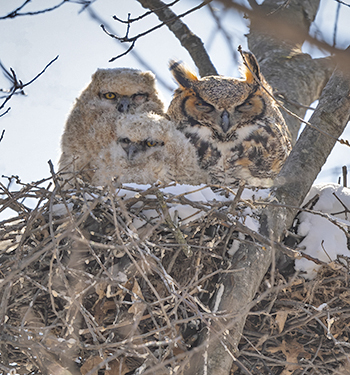
Great Horned Owls usually lay eggs in late January or the first of February. They will hatch in about 30 days, certainly by the time you will read this article. They raise only one brood a year, usually with 2 owlets. I observed the Garden owls mating the month of January and first week of February just outside the Garden. As of February 15, it appears the owls have chosen a nest in the pines just east of the Garden. The female assumes primary responsibility for incubating the eggs while the male brings food for her and the nestlings. If all goes according to plan, hatchlings should appear around the second week of March. By the end of March, you may hear the owlets clapping their bills or shrieking, as they beg their parents for food. Around the middle of April, they will begin climbing from the nest to nearby branches. They are called “branchers” then and you can see them sitting in the sun. After developing wing feathers in early May, they become fledglings as they clumsily learn to fly from branch to branch. They will move out of the nest by mid-June and will be moving around more as they learn to fly and hunt for food.
You’ll have to search to find them. The adults care for the juveniles throughout the summer and fall, feeding them while teaching them to hunt until they reach sexual maturity in 1-2 years. The feeding territory established by the adults usually cannot support more owls so the juveniles are chased out of the territory by their parents usually in December before the next breeding season. Occasionally, one may hang around a bit longer still begging for food.
The white, speckled downy feathers on the breasts of the owlets make them easier to find than the adults. If you find an owlet, look around. An adult owl will always be nearby protecting it and more important, feeding it. If you hear the alert calls of Blue Jays or American Crows, look around. There’s a good chance they have found the owls and are harassing them. They don’t get along.
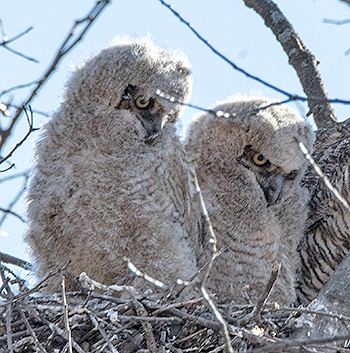
When you see the Great Horned Owl and their owlets, you will be mesmerized. Try not to stress them by making noise, making hooting calls, trying to make them fly or by getting too close. You might even consider watching owls and other birds as a hobby. Bird watching gets you out of the house into nature for some exercise and will give you something fun to talk about with your friends. Oh, you’ll also see some fantastic birds that otherwise go unnoticed. To learn more about birds and observe them in the Garden, considering joining Garden Naturalist Tammy Mercer on Saturday mornings for the Early Birders program from April through October. (Special thanks to Tammy who helped with this article).❖
Web references:
international owl center - https://www.internationalowlcenter.org
Rod Miller is a neighbor of the Garden, former volunteer, and participant in its programming.
This article was originally published in The Fringed Gentian™, Vol. 69 No.1, Spring 2021.
Part II - The Garden Owls are Thriving
by Rod Miller
Three years ago I reported on the Great Horned Owls of Eloise Butler Wildflower Garden and Bird Sanctuary (“Owls of the Garden,” Spring 2021, VOL. 69 NO.1). We were one year into the COVID pandemic. We emerged from it a year ago but with caution. The owls that live in and around the Garden didn’t seem bothered and are thriving

Since my last report, they confiscated three Red-tailed Hawk nests near the entrance drive of the Garden and a Cooper’s Hawk nest in the fork of a White Pine just outside the Garden that overhangs the restrooms. They produced five offspring, only one of which failed to survive because that one fell from the nest last year.
Visitors to the Garden and the surrounding Theodore Wirth Regional Park are captivated by the distinctly different calls of the male and female Great Horned Owl. The male’s melancholic call consisting of four to five syllables, “hoo-h-HOO-hoo-hoo,” is low and slow compared to the recognizably higher pitched, seven-syllable melodic call of the female. Most owls are nocturnal, so you are more likely to hear the owls at dusk when they are waking up after sleeping all day and before heading out to hunt for food.

The Great Horned Owl mating season begins in December with vocalizations that are often called the “mating duet.” Many visitors to the Garden report hearing them. The owls breed during the month of January, and this year the female chose a nest near the Quaking Bog in early February. The male searched for nests and presented her with several options but she ultimately decided. The eggs she laid hatched about 32 days later in mid-March.
Look for the owlets on branches in mid-April as they exercise their wings preparing to fly. They will fledge in late May, so you may see their clumsy short-distance flights. The parents will feed them throughout summer and fall while their mother teaches them to hunt. By October, the parents will ignore their loud and persistent begging for food, forcing them to fend for themselves. By November, they will force the juveniles to move out of the territory, sometimes quite aggressively.


Barred Owls have lived in and near the Garden for several years as well and have been very active. For the last three years, they have nested in tree cavities within 100 yards of the Garden, raising six offspring, all of which survived. Their distinctive two-sentence call: “Who cooks for you? Who cooks for you-all?” is recognized by visitors and is often heard during the day from inside the Garden. At the end of the first week of March, the Barred Owls made their nest in the cavity of a tree within the Garden. This is the first time owls have nested inside the Garden in at least 20 years, according to Garden Curator Susan Wilkins and birding Naturalist Tammy Mercer. The Great Horned Owl and Barred Owl are archenemies, so it is very unusual that they have nested within 100 yards of each other for three years in a row. Perhaps they’re just being “Minnesota nice!” or have learned to get along. Listen and look for them when you visit the Garden and the surrounding woods.
The highly secretive, bright yellow-eyed Saw-whet Owl is a newcomer to many who bird in Wirth Park. Several birders in the Early Birders Program have seen Saw-whet Owls in the northern sections of the Park near the Trailhead and the Chalet.

A small owl, it is almost exclusively nocturnal, so it is very difficult to find while roosting in small clumps of cedar trees during the day. We have yet to see a Saw-whet Owl close to the Garden but we are always looking.
Two members of the Early Birders program recently reported seeing what they believe is the elusive Long-eared Owl not far from the Garden in Wirth Park near Bassett’s Creek. One was able to get a photograph of the owl in flight. I joined their search but I am still looking.
Everyone is welcome at the EBWG Early Birders program. A Garden naturalist guides birders through and around the Garden on Saturday mornings from April through October. You can find information about the program and the schedule on the Garden’s website and Facebook page.
There are many printed and online bird guide references for owls. I like one-stop shopping at the Cornell Lab’s “All About Birds.” ❖
Saw-whet Owl with lunch on the branch. Photo below and above by Christopher Boser

This article was originally published in The Fringed Gentian™, Vol. 72 No.1, Spring 2024
Part III - Historical notes on the Owls in and near the Wildflower Garden
Eloise Butler
The Garden logs of Eloise Butler record the sighting of owls that she saw fit to mention in her records. Here is a sampling of her notes:
- 28 November 1908: "noted three blue jays chasing a Barred Owl out of the Garden"
- 26 October 1916: "Noted in garden a small hawk and great horned owl."
- 1 April 1917: "a large gray western great horned owl was captured in the vicinity of the Garden."
- 13 April 1924: "Noted screech owl perched in a young hemlock tree north of the tarvia road. Sat motionless for a long time, and permitted near approach."
During Martha Crone's tenure as Curator future Friends President Robert Dassett visited the Garden and later wrote this comment:
"Robert and wife Betty were there when Martha’s husband Bill discovered a barred owl perched rather close on a tree branch. All four went to gaze at it, and the owl just sat and stared back at them, seemingly curious and unafraid."
Comments of former Curator Ken Avery
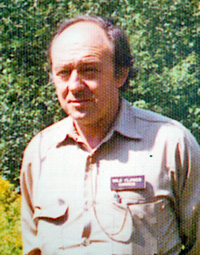
The person who wrote most extensively about the owls was the man who succeeded Martha Crone as Curator/Gardener.
- January 1973: One old friend that gave me a fright last year is back, however, and seems to be ready to stay — our Great Horned Owl. Last year I saw him a few times in late fall and then not one more time all winter. I was afraid the greatly expanded winter use of the area all might have but he discouraged this shy bird and that he had secured more remote lodgings, but he is back as usual this winter.
I should also report that the Saw-whet Owl, a bird that is not at all common in this area, showed himself to me at the spring about a week before Christmas. I have seen the species in the Sanctuary once before about nineteen months ago when one was seen in a white pine by the front gate at about five-thirty one afternoon and it was at the same place at the same time again the next day. I went back time and again to see if this were this were his schedule but I did not see one again until this December. - April 1974: This last February I saw a Saw-whet Owl. This is the third time I have seen one. It is a little earless owl about 7 inches long (a Blue Jay is 10 inches long) and is supposed to be a very common bird. However, most people have never seen one. I saw my first Saw-whet two years ago in April. A Birder, who had come in often, told me that she had seen one a few days earlier and when she pointed to where it had been, there it was. I thought that it might have a routine that brought it there each day at that time so I looked for it every day for a few weeks but I never saw it again that year. The next one I saw was at the spring north of the Garden. It was in December a year ago. I was walking from the spring to the parking lot when a bird flew across the road into a cedar a few feet from me. I stepped over and ten feet above me was a little owl. The next one was at almost the same place this last February. I had just parked the truck at the spring and was walking away when a Blue Jay started making an awful fuss in tile cedars and then two birds flew across the road--it was a Blue Jay chasing an owl about its size.
- April 1974: I also have some other owl news from last year. The Great Horned Owl has wintered in the Garden many years, more than I have been there, and we have assumed that they nested in that area — they nest in February. I had even seen two of them making overtures, but until last summer we had never seen the nest or their young. Last spring someone reported that they had seen a young owl in the wild area west of Birch Pond. We found one of the young and a few days later found a second one. They both disappeared, but then I saw one in the fall fully grown. Now I have a second-hand report of the owl nesting in the park again, but I have not seen it personally.
- April 1975: Another thing that is happening is that the Great Horned Owl is busy having a family again. This may seem like a strange time to be sitting on a clutch of eggs but it is the time that the Great Horned Owl picks. I would think it would be a little uncomfortable, and I must say when I saw her half covered with snow she didn't have a terribly happy expression on her face; but she has no one to blame but herself. This is the third year in a row that we have been aware of the owl nesting in the area. I have no way of knowing if one nested there for the last 20 years, but since we have found it for the last three years and never did before, I wonder if during those high D.D.T. years they did manage to nest or if we simply managed to miss it. You know that the eagles have been having better nesting success these last few years since the D.D.T. has become less prevalent in the environment.
- April 1977: Well, Spring is here. I know she is because she is in bloom (in the form of Snow Trillium) down under the hemlocks by the back gate. However, on Sunday (April 3) I saw The Owl and The Owl is our bird of winter. As long as I have been here, the Great Horned Owl has spent the winter in the vicinity of the Garden and would disappear shortly after we opened and people began to arrive, and then would reappear again in the fall as the people became less evident. I assume that the owl which I saw fly over - chased by three crows - was our owl (a Great Horned Owl), but last winter I did see a Great Gray Owl here in the Garden and they are approximately the same size so I could be wrong.
Ken Avery was Curator/Gardener at Eloise Butler from 1959 through 1986. His comments were originally published in The Fringed Gentian™ during those years.
Part III - Rescue of Great-horned Owl
In 2014 an injured Great-horned Owl was found just outside the Garden fence. It was re-habilitated and then release. ARTICLE