
Friends of the Wildflower Garden
Brilliance of the Forest - Slime Molds
by Ron Spinosa
Hey, did you hear the one about the slime mold in a maze? No, this is not a joke — slime molds are smart enough to solve a maze. If you are ‘amazed’ by that feat, you will be even more surprised to learn that scientists recently created a robot that uses a slime mold as its brain — a slime-bot.
Not a Plant - Not an Animal
Until recently slime molds belonged to a group of organisms called Myxomycetes, or “slime-fungus.” But slime molds are not actually fungi. They are in the same kingdom as amoebae and have more in common with animals than fungi. Their new name, Mycetozoa, means “fungus-animal,” and indeed, they move around and ingest food in a manner similar to amoebas, but reproduce like fungi, by shedding spores.
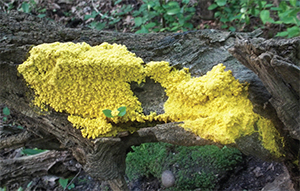
Let’s take a look. The slime molds you might see in the Garden are called “plasmodial” slime molds. This type of slime mold has a two-stage life cycle, and appears quite different during each stage. In the feeding or vegetative stage it is known as a “plasmodium.” Think of it as a giant amoeba that contains myriads of nuclei enclosed in a single cell membrane. It creeps and crawls like an amoeba, using pseudopods for locomotion. It is in fact a single cell of colossal proportion— indeed, the largest cell found in nature.
The color of a plasmodium can be red, yellow, orange or white, depending on the species of slime mold. You might encounter the plasmodial stage as a blob of yellow living slime networked with veins. The blob moves too slowly to observe its motion– a millimeter or so per hour. You can find plasmodia in cool, shady, moist habitats such as rotting logs, stumps or leaf litter. Slime molds are “detriti-vores,” meaning they eat bacteria, organic debris and sometimes fungi, breaking down rotting vegetation and recycling nutrients for other species to utilize. They are eaten by organisms such as slugs, insects and even fungi. There is an entire family of slime mold beetles, Sphindidae, that feed exclusively on slime molds.
Fruiting Bodies
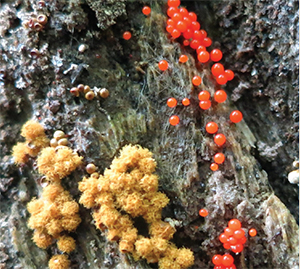
When food becomes scarce or environmental conditions are unfavorable, slime molds shift into the reproductive stage. They undergo an amazing metamorphosis and transform into “fruiting bodies,” as different from plasmodia as a butterfly is to a caterpillar. A magnifying glass is needed to appreciate the fruiting bodies of most species, of which there are hundreds. Fruiting bodies are only about a millimeter tall and typically consist of a spore capsule on a stem, like a golf ball on a tee. They can be exceedingly beautiful and are well worth the effort to seek out. A few species of slime molds have considerably larger fruiting bodies. Dog vomit slime mold, Fuligo septica, can be as big as a dinner plate and resembles exactly what its common name implies. Another species that is easily spotted is the chocolate tube slime, Stemonitis splendens, which looks like a tuft of horse hair on the surface of a log.
Slime Solver - Slime Bot
The slime mold of “slime-bot” fame, studied in labs all over the world, is of the plasmodial type, Physarum polycephalum. It creeps forward in search of food by projecting fan-shaped pseudopods. The protoplasm in the veins flows forward for a few seconds and then reverses direction, repeating as it advances. This process of movement, as well as a skill at finding food and a tendency to shy away from light, inspired two fascinating experiments. In one experiment, P. polycephalum was able find its way through a maze using an oatmeal flake placed at the entrance and another at the exit. The slime mold explored the entire maze and then retreated from dead ends or lengthy paths and connected the two food sources with a single vein. It had discovered the shortest path.
In another case, slime mold was grown on top of a circuit connected remotely to a small six-legged robot. A bright light was projected, and as the slime mold tried to move away from the light, its movement was sensed by the circuit. With the slime mold acting as its brain, the robot scrabbled away and hid itself in a dark place. Welcome to the world of intelligent slime!

From left to right) CHOCOLATE TUBE SLIME MOLD, Stemonitis sp.; WHITE CORAL SLIME MOLD, Ceratiomyxa fruticulosa; RASPBERRY SLIME MOLD, Tubifera ferruginosa (black are more mature); WOLF’S MILK SLIME MOLD, Lycogala epidendrum; YELLOW-FUZZ CONE SLIME MOLD, Hemitrichia clavata (immature) photos: Maia Campbell and Ron Spinosa❖
Ron Spinosa is an amateur mycologist, a retired naturalist and a Garden volunteer.
This article was originally published in The Fringed Gentian™, Vol 66 no 3, 2018.