Friends of the Wildflower Garden
P. O. Box 3793
Minneapolis, MN 55403
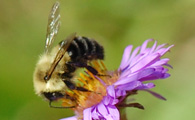
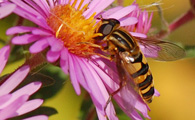
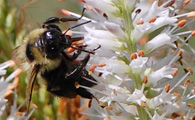
Eloise Butler Wildflower Garden Bee Surveys
First Survey 2013-2014
Over the two seasons of 2013 and 2014, The Friends of the Wild Flower Garden helped fund a survey of bee Species in the Garden in order to determine baseline data of represented species. As many of you know, the decline of honeybees (Apis mellifera) has been a great concern of many people. But honeybees are only one species of bee out of many that do the work of pollinating plants and fulfilling a niche in nature.
What was to be established by this survey was baseline data on how many species of bee are active in the Garden and as an additional data point - which plants they frequent.
A key reason for collecting this data will be for future comparison as there is little baseline data of this sort available for any specific location. So, while we are concerned about what is happening to honeybees, we don't know what is happening to other species due to lack of comparable data.
Entomologist Elaine Evans was hired by the Garden to perform this study during the Garden seasons. Entomologist Evans suspected that there are over 50 species of bees that would be found in the Garden.
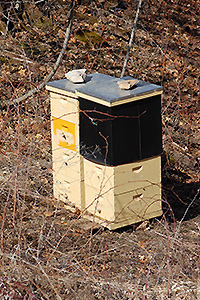
Many visitors to the Garden in 2012 observed two bee hives placed in the Upland Garden. They were kept in place and active during the survey seasons. Garden Curator Susan Wilkins stated that only three hives that overwintered in the Park System survived the winter of 2012/2013. The two in the Garden were of those three.
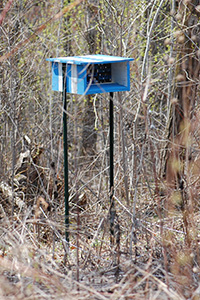
The blue and white box on stilts placed in both the Woodland and Upland Garden are nesting boxes for tunnel nesting bees that make their nests in stems. Most species nest in the ground but for those that nest in stems these boxes are fitted with channels that the bees should accept as nesting places and then information about them could be gathered also.
The sample data gathered here will be used for future monitoring and environmental education programs for the entire Parks System.
To the surprise of all, the survey found 104 bee species not counting the honey bees. The honey bee hives in the Garden are being removed in order to focus on some of those other 104 species.
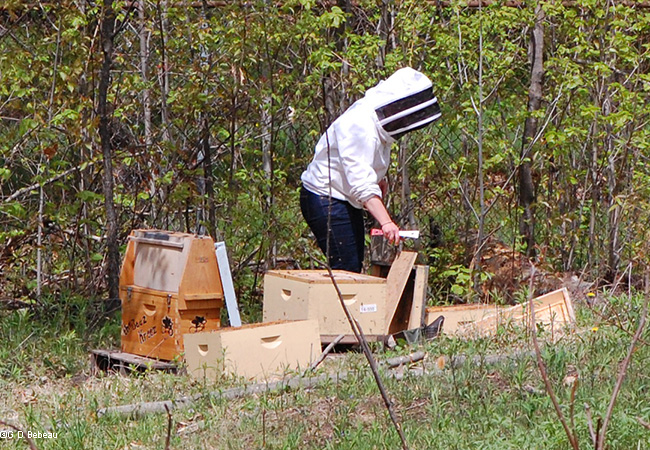
Below: The entomologist doing spring housekeeping on a honeybee hive in the Garden - Spring 2014
Information from the survey
Some of the interesting results:
On the many species found, some were represented by only one individual.
While most bees are generalists, several specialists were found only on Lead Plant or on Helianthus species.
The top plants for bee abundance was Filipendula ulmaria, thistle, Helianthus, Lead Plant, and Solidago.
The most diversity was found on the goldenrods (Solidago) and second on Gray Dogwood (Cornus racemosa).
There was less bumblebee diversity in the Garden vs other gardens surveyed at the same time, such as the Peace Garden near Lake Harriet.
Second Survey 2023-2024
After months of effort the MPRB finished a contract with the University of Minnesota Bee Lab to begin a new 2-year bee survey of the Wildflower Garden. This would update the one from 10 years ago and be under the direction once again of Dr. Elaine Evans. The Friends would pay up to $5,000 of the cost.

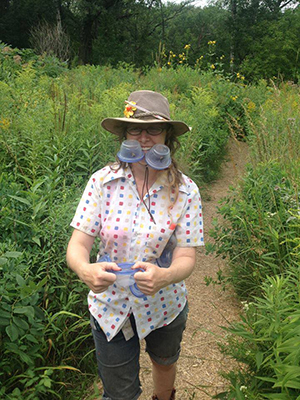
On three weekend days during the summer the Garden put on a Bumblebee Community Science Program in conjunction with the second year of the Garden’s decennial bee survey. Staff from the University of Minnesota Bee Lab instructed Garden visitors on how to capture bumblebees which were then identified by species by the lab staff. The final event on August 3rd wrapped up the survey and during the upcoming winter of 2025 the lab with be tabulating the results of the survey.
Below: Bumblebees collected for the Bee Survey are sorted by type of plant found on, prior to identification by the Bee Lab staff.
