Friends of the Wildflower Garden

Eloise Butler Wildflower Garden Florilegium Project
The 2026 exhibition
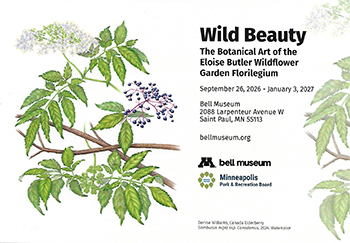
An exhibition of all 111 drawings is planned for the Bell Museum at the University of Minnesota in the fall of 2026, opening on September 26 and running until January 3, 2027. An exhibition catalogue will be available. The Bell is located at 2088 Larpenteur Avenue West, Saint Paul MN 55113.
History of the project
In the 2010 Fall issue of The Fringed Gentian™ Garden Curator wrote about the beginnings of this project.
A partnership with the Minnesota School for Botanical Art (MSBA) has been developing over the past many months which will result in a truly remarkable creation—the development of a florilegium for the Wildflower Garden. A florilegium is a collection of artwork depicting plants at a specific location, in this case the Wildflower Garden. The project will document many plant species to provide a visual historical record of the Wildflower Garden’s flora.
Beginning this fall, current and former MSBA students and teachers will be invited to create original paintings of Wildflower Garden plants. The paintings will be traditional botanical artworks presenting a scientifically accurate image of each chosen plant. The project will continue for several years. Paintings accepted into the florilegium will be donated to the Minneapolis Park and Recreation Board for display and for use in providing educational programs and services to the community.
The Garden has inspired many individuals and groups to explore the natural world as artists or because of the endeavors of artists. As the arts-based programs and partnerships continue to grow and evolve at the Garden, so will the depth and beauty of our collective appreciation of our amazing botanic garden.

Florilegiums date back to the 15th century, when explorers would take artists with them on their travels to record the flora and fauna. But there hadn’t been much call for the practice until 2000, when the Brooklyn Botanic Garden and the Filoli Florilegium in Woodside, Calif., both launched their own florilegium projects. The Eloise Butler Wildflower Garden florilegium was the third contemporary American florilegium to get underway.
Marilyn Garber, who has been visiting the Garden since moving to Minnesota in 1969, had been looking for “the right place” to do a florilegium since she started her school of botanical art in 2001. She thought the Garden’s beauty and history seemed perfect, but she wasn’t quite decided until one day, while walking the Garden’s paths, she lost her car keys. After looking everywhere, she went to the shelter to see if she could call a friend to bring out her extra set so she could get to work on time. “And one of your wonderful volunteers offered to take me to my house, get the keys and bring me back,” she recalls. “I thought, ‘These are nice people here. This is where the florilegium needs to be.’”
Susan Wilkins initially selected the 110 plants to be included in the florilegium. Plants were representative of each part of the garden, and Wilkins also chose a few plants that were important to Eloise Butler. She expected to take six to eight years to complete the project. Much of the timing depended on Mother Nature. “Our goal is to finish a painting in one year, but some can take two to three years to complete because the weather doesn’t cooperate,” she explained. "If the plant doesn’t bloom well or produce pods the way it usually does, we have to wait another year to paint those stages the plant normally goes through in order to document all of them.” The need to preserve the legacy of the Garden, and the plants inside the gates, is a key motivator for Garber. She says: “I want this little jewel of a place to be remembered five hundred years from now.”
When the Friends of the Wildflower Garden held the annual volunteer appreciation event on November 7 at the Kenwood Cafe in Minneapolis, Marilyn Garber gave a brief talk explaining the Florilegium Project.
By spring of 2011 more than 50 of Garber’s students began working on their first drawings for the Florilegium Project. Field work was slightly disrupted by the tornado that touched down on the west side of the Garden on May 11.
By the summer of 2013 a sufficient number of drawings were completed and the long awaited opening exhibition of the Eloise Butler Garden Florilegium took place on the evening of August 23 at Longfellow House in Minnehaha Park. Artists were present, refreshments were served, Bluegrass music was played. Friends President Pam Weiner manned a table of information about the Friends. The exhibition announcement featured a Sensitive Fern (Onoclea sensibilis) on the cover by artist Linda Powers.
Below: Two images from the Eloise Butler Florigieum Project, 2010-2014, MPLS School of Botanical Art.


The next event was the exhibition opening of the Eloise Butler Garden Florilegium at the Minneapolis Central Library on August 14 2014. Forty-five paintings of native plants from the Wildflower Garden were exhibited. Susan Wilkins and Marilyn Garber (head of the School for Botanical Art) spoke about the history of the Wildflower Garden and the history of the botanical art school. MPRB Superintendent Jayne Miller also spoke. The Friends paid $300 for some of the refreshments provided, the Friends of the Library paid for the remainder. Pam Weiner manned a Friends Table and a number of other board members were present.
Below: The entrance to the Florilegium Exhibition on August 14th. Photo - Melissa Hansen


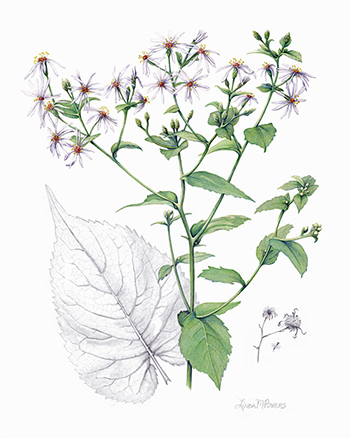
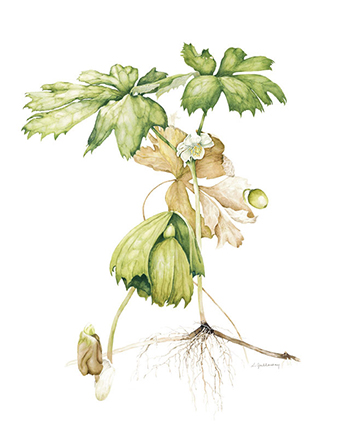
Over the next few years new artists worked on more drawings. From 2010 through 2015 forty-six illustrations had been completed and donated to the Minneapolis Park & Recreation Board with twenty-six artists contributing works to the collection.
During the entire season of 2019, drawings were on display at the Crone Shelter. By this time over 70 works had been completed and accepted.
The project was destined to take longer than the initial estimate. The Covid epidemic of 2020-21 that affected gatherings and working together slowed down the progress. A sign of nearing completion was an exhibition held at the Minneapolis Institute of Arts over the winter of 2023/2024.
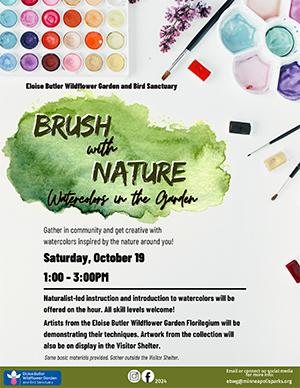
In the Wildflower Garden, some of the artists demonstrated the process of making a drawing at the Martha Crone Shelter on October 19, 2024. (see poster) Some completed work was on display. As 2024 ended, the adjusted goal of 111 drawings was being approached and consideration was being given to production of a book to further document this work.
The 2026 exhibition
An exhibition of all 111 drawings is planned for the Bell Museum at the University of Minnesota in the fall of 2026, opening on September 26 and running until January 3, 2027. An exhibition catalogue will be available. The Bell is located at 2088 Larpenteur Avenue West, Saint Paul MN 55113.