Bee Activities
Bumblebees Bees have fun
Children play, animals are seen to play, even some birds play, but bees?? Decades of research indicate that bees will engage in play activity unrelated to any reward. The video linked here is great fun.
Bumblebees seem to have a ball rolling around plastic balls. The test of whether it is play or not is that it
(1) did not contribute to immediate survival strategies,
(2) was intrinsically rewarding,
(3) differed from functional behavior in form,
(4) was repeated but not stereotyped, and
(5) was initiated under stress-free conditions.
Below - Frames from a video of bees rolling round balls.
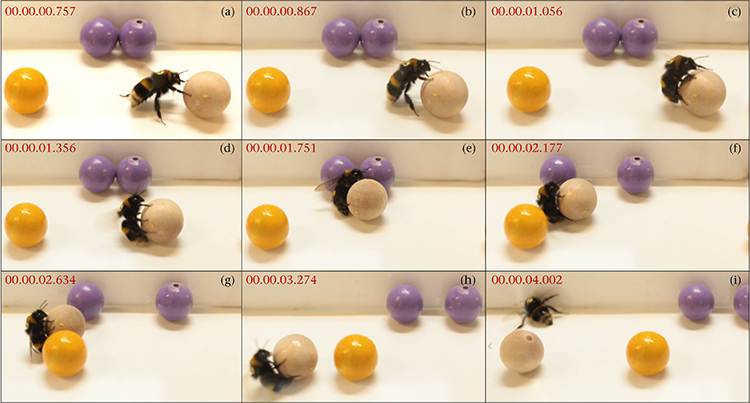
Initially the experiment was to train bees to roll a ball in order to access food, but the researchers noted that bees would roll the ball around for no apparent reason. Then they made food freely available at any time the bees wanted it and also provided access to a different chamber where they could play - many bees chose to play when they could - Furthermore - bees that had not had the early training would roll balls after observing others doing it.
This video link will show 90-seconds of their activity. The most fun part is at the end.
The main researchers of this work were Hiruni Samadi Galpayage Dona and Lars Chittka of Queen Mary University, London. Dr. Chittka has spent his entire career studying the habit of bees. He was always chagrined when colleagues in animal and bird research would report on play activity, so he decided it was time to experiment.
You can read all about the experiment setup and full results in the article recently published in Animal Behavior - link to pdf version of the study
The article and video are open access under the Creative Commons CC BY 4.0 license
(creative commons licenses)
Do bumble bees play?
Authors: Hiruni Samadi Galpayage Dona (a), Cwyn Solvi (a, b), Amelia Kowalewska (a),
Kaarle M€akela (b) , HaDi MaBouDi (c) , Lars Chittka (a)
a School of Biological and Behavioural Sciences, Queen Mary University of London, London, U.K.
b Ecology and Genetics Research Unit, University of Oulu, Oulu, Finland
c Department of Computer Science, University of Sheffield, Sheffield, U.K.
Bumblebees Use Tools
In the previous article we demonstrated bee play activity. Dr. Lars Chittka has another experiment that shows the ability of the tiny brains to learn to use a tool.
It was already known that insects can solve some cognitive tasks. Many times those tasks are similar to their foraging techniques. But what about a task that they do not perform for foraging or for any other purpose - such as using a tool.
Among several experiments that demonstrated the ability here is one example that requires a bee to pull a string to obtain nectar.
Watch the short video and believe. Furthermore - other introduced bees observing the behavior were able to duplicate the activity. Here is a pdf of the research article.
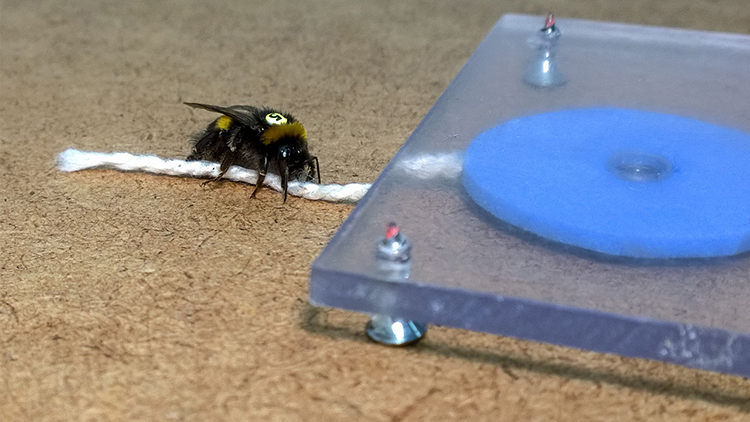
The main researchers of this work are from of Queen Mary University, London. Dr. Chittka has spent his entire career studying the habit of bees.
Social Distancing - it's not so new, and bees adopt it also!

When the plague returned to Alghero Sardinia in 1582, the Protomedius (area health official) Quinto Tiberio Angelerio quarantined the city and set rules that forbade citizens from leaving their houses, except that one person, familiar with the rules, could leave a house to do the shopping; banned public meetings and entertainments; set procedures for disinfecting; forbad shaking hands; and required people who did go out to carry a six foot cane, used to keep that distance from one another.(1)
Does any of this sound familiar after the covid pandemic?
Social distancing in bees.

A recent study determined that honeybees know how to avoid each other during a plague - the plague for bees being the hive parasite Varroa destructor, the mite causing hive (or colony) collapse. To reproduce the mites must migrate to the nursery cells of the hive, which are found in the center, to lay their eggs. In normal hives arriving forager bees do their waggle dance, announcing a food source, within many parts of the hive and grooming by bees to remove debris and parasites from each other (called “allogrooming”) takes place throughout. But in infected hives, the waggle dance is mostly restricted to the entrance of the hive so that infected foragers do not penetrate to the center and more grooming is concentrated in the center to protect the nursery cells and remove mites. (2)
Notes:
(1) Published later as Ectypa Pestilentis Status Algheriae Sardiniae (1588), by the Protomedicus Quinto Tiberio Angelerio (1532–1617). Honeybee photo - University of Minnesota.
(2) “Honey bees increase social distancing when facing the ectoparasite Varroa destructor,” by Michelina Pusceddu, Alessandro Cini, Simona Alberti, Emanuele Salaris, Panagiotis Theodorou, Ignazio Floris, Alberto Satta Published in Evolutionary Biology 2021