The Friends of the Wildflower Garden
Planting guide for native Loosestrifes

If you pick and choose wisely, the loosestrife family has a species for everyone and everywhere - sun, shade, wet. The colors are primarily yellow with a few pink, usually 5 petals but all loosestrifes can occasionally have extra petals. Most plants grow to two feet or more in height. The Eloise Butler Wildflower Garden is graced with examples in all 3 habitats. All however, require certain amounts of moisture and are not recommended for dry upland environments.
All the recommended species are native to Minnesota but vary in flowering times. Most are available from native plant suppliers as plants or seeds.
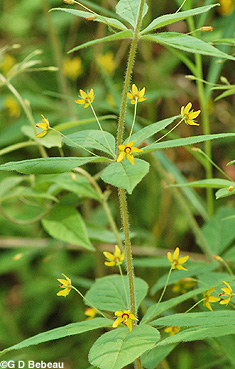
For light shade you have one good choice with fringed loosestrife (Lysimachia ciliata) which is indigenous to Eloise Butler Wildflower Garden. The flowers are on long stalks from the upper leaf axils. It will also grow in full sun if it has plenty of moisture. "Fringed" refers to fine hairs on the stem nodes and leaf stalks of the lance shaped leaves. It is usually found along violet way in the woodland in the Wildflower Garden where it blooms from early to late summer.
For upland sunny habitats with adequate moisture, the whorled loosestrife (L. quadrifolia) is beautiful and so named as the leaves, wedge shape to rounded, are in a whorl, usually of 4. This species is special to the Wildflower Garden as it is rare in Minnesota and on the state special concern list, but it likes the Garden’s habitat as it has grown in large numbers in the Upland Garden, particularly on Aspen Alley. The long-stalked flowers spring from the upper leaf axils, also in whorls, and have a very showy reddish band at the base of the stamens. It flowers from early to late summer.



Another upland candidate is prairie loosestrife (L. quadriflora), also called “4-flowered loosestrife” because flowers can form in a whorl in groups of 4. One drawback can be the thin stem. It can be overpowered by larger neighbors and lean unless it has an adequate moisture source. The petal tips are more ragged than fringed loosestrife but have a similar point to the tip. Leaves are long but only 1/4 inch wide. It comes into flower in mid-summer.

For wet environments you have three choices: tufted loosestrife (L. thyrsiflora), swamp candles (L. terrestis) and winged loosestrife (Lythrum alatum). These do not mind wet feet as long as it is sunny. Swamp candles has that reddish band at the base of the stamens but, unlike the others noted here, the yellow flower many times has more than 5 petals. The flowers are in a raceme atop the stem, not rising individually from leaf axils. It blooms in early summer and usually grows to 3 feet.


The tufted loosestrife (L. thyrsiflora), also indigenous to Eloise Butler, has an all together different appearance. While the flowers spring from the leaf axils, they are small and grouped into a compact egg shaped inflorescence called a thyrse. These rise from the middle stem leaf axils. Once you see it you will confuse it with other loosestrifes. The leaves are opposite, long and narrow. Flowering is late spring to early summer.

The third wetland choice is also for the most moist areas, winged loosestrife (L. alatum). You may have noted above is in a different genus - Lythrum. The flowers are lavender to rosy pink, in the leaf axils but not on long stalks. It prefers the edges of wetland and riparian areas and adds a different color to the landscape as it blooms in early summer. This is a sturdy plant, taller than the others.
Do not confuse winged loosestrife with its cousin introduced from Europe as an ornamental, purple loosestrife (Lythrum salicaria), which is one of the most invasive plants in North America and has been on the Minnesota Prohibited Control Noxious Weed List for the last 33 years. Purple loosestrife shares the same habitat but flowers in late summer. You will not fine it in the Wildflower Garden but it is easily found around the metro area in marsh habitats. ❖

