The Friends of the Wildflower Garden
Monarch Butterflies
Article 1 - Saving the King
Article 2 - 2024 update on population numbers
Saving the King
by Diana Thottungal
By now just about everyone interested in nature knows that the Monarch butterfly population has been decreasing dramatically. A recent estimate places them down by about 86%.
Rather than just mourning the loss of this beautiful creature, a few things can be done to help them survive.
1. PLANT MILKWEED, the food their caterpillars eat. The Common Milkweed (Asclepias syriaca) grows easily from plants or seeds, depending on how green your thumb is. If your thumb is very green, google “free milkweed seeds,” and, if they haven’t run out, you can do your good deed for free, and even share the sprouted plants with friends. For less green thumbs like mine, already-started plants are available for purchase. There are other local Milkweeds that are a bit less attractive to Monarchs, but, if your garden is better suited to a different species, try the bright orange Butterfly Weed (A. tuberosa) if your garden tends to be dry, or plant the fragrant Swamp Milkweed (A. incarnata) for damp or woodsy areas. Swamp Milkweed can also be found with the Rose Milkweed name.
2. PLANT SOME OF MONARCH’S FAVORITE NECTAR PLANTS like Meadow Blazing Star (Liatris ligulstylis), Stiff Goldenrod (Solidago rigida), or the proposed Oligoneuron rigidum, in addition to Anise Hyssop (Agastache foeniculum).
3. PERSUADE YOUR FRIENDS to include some of these same plantings in their gardens. The plants mentioned above are available from many nurseries including the local Prairie Moon.
Some Monarch enthusiasts may prefer a more hands on approach for saving Monarchs. If you come across tiny white eggs on the underside of Milkweed leaves or baby caterpillars crawling around on the leaves, pick the top part of the plant along with any eggs or baby caterpillars to bring inside and put this stem in water. It’s a good idea to put some paper towels under the container, so the caterpillar droppings don’t harm the surface underneath. If you bring in Monarch caterpillars or the eggs hatch inside, you are preventing them from becoming bird, insect, or spider food before they can transform into butterflies.
You might be surprised that birds are listed among Monarch caterpillar predators because you may have seen evidence in publications which indicate birds won’t eat these caterpillars because they taste bad. Well, that’s almost correct. In fact, the young caterpillars haven’t eaten enough milkweed to have acquired the bitter taste, so birds are perfectly happy to eat them up to a moderately large caterpillar size. Birds actually are not the only Monarch predators; Ladybird Beetles and Yellow Jacket Hornets as well as various spiders like to munch on these striped caterpillars.
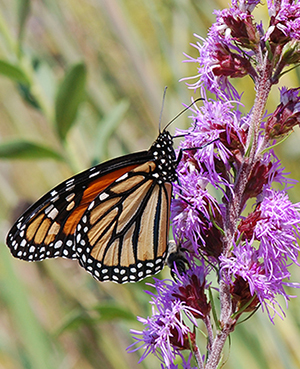
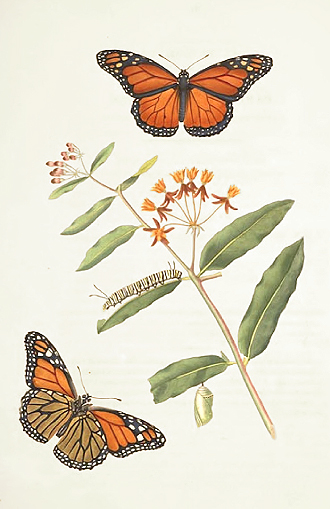
BUTTERFLY WEED (Asclepias curassavica) AND MONARCH BUTTERFLY (Danaus plexippus, as Papilio archippus). Hand-colored engraving by John Abbot (1751-1840). The natural history of the rarer lepidopterous insects of Georgia, volume 1 (1797) from the Swallowtail Garden Seeds collection of botanical photographs and illustrations.
By bringing Monarch eggs and small caterpillars into safety inside, you are providing a safe environment for caterpillars who will eventually go into the transitional pupal stage.
Once the Monarch caterpillars reach their full size in about 9 to 14 days, you may soon find them hanging in a kind of J shape. Within 10 to 15 minutes the change begins as each little being encases itself inside a chrysalis. If you are not there to witness this transformation live, you can check out this video on YouTube http:://youtu.be/b4WYor6UMtU
.Once the clear chrysalis has formed and transformation has begun, gold spots can be seen forming. All the butterflies in the same family with Monarchs emerge with some kind of metallic-like spots, yet no one seems to have identified what function they serve, but apparently they provide some kind of evolutionary advantage for the adult butterflies. The developing Monarch inside the chrysalis gradually changes coloring to yellow and orange pigments with the metallic sheen coming from the microscopic structure of the dots.
It’s a good idea to put the hanging chrysalis outside once it stops looking green and the orange and black butterfly colors show through. If it does emerge inside, know that it takes some time for the wings to dry and extend properly for flight, so you can still get it outside in time for it to fly away. Just hope these butterflies make it to the famous Mexican Monarch wintering spots on oyamel fir trees in the Michoacán and Mexico states, so this miraculous cycle can begin again.
Diana Thottungal is a retired Garden naturalist.
For more information on the plants mentioned in the article use these links:
Common Milkweed
Butterfly Milkweed
Swamp Milkweed
Anise Hyssop
Stiff Goldenrod
Blazing Star
This article was originally published in The Fringed Gentian™ Vol. 67 No. 1
Another decrease in wintering monarchs - 2024 update
Recent news headlines have run something like this:
Eastern migratory monarch butterfly populations decrease by 59% in 2024
It does read like something heard once before, doesn’t it? Indeed, the chart below shows that the trend of the last 30 years is a downward slope in population of the Eastern Monarch Population which is the set that populates North America from the great plains eastward and winters in the Neovolcanic Range of central Mexico. This winter’s estimate is that the monarchs occupied only 2.2 acres, 59% less than the previous winter.

This survey is taken annually by the World Wildlife Fund. A quote from their latest report:
This season's largest colonies were detected outside the Monarch Butterfly Biosphere Reserve, with 0.84 acres in the Palomas sanctuary, and 0.5 acres in the Peña Ahumada sanctuary, both in the State of Mexico. In El Rosario, in the Sierra Campanario sanctuary, Michoacán, where the largest colony is traditionally located, the butterflies occupied an area of 0.46 acres. Data recorded in 2023-2024 represents the second-smallest area occupied by monarch butterfly colonies in Mexico since 1993, when population monitoring began, only preceded by the 1.7 acres observed in 2013-2014. The largest recorded population was in 1996-1997, with 45 acres monitored.
Below: Monarchs of the eastern population in refuge in Mexico. Photo: Count Whelan Photography.

For more documentation of the eastern population winter reports use this link to Monarch Joint Venture: https://monarchjointventure.org/blog/eastern-monarch-butterfly-population-falls-to-less-than-one-hectare-in-the-2023-2024-overwintering-season
The Western migratory monarch population is not faring much better. This group migrates in summer to the area of the Rocky Mountains and westward, then winters in many sites along the coastline of California and Baja California. This group also had the largest population 30 years ago, then dropped off precipitously and then held somewhat steady for many years until another plunge in 2018, followed by some recovery in 2021 and 2022, with enthusiasts rejoicing, only to see another decline this winter.
Below: A group of the western monarchs in refuge.

For more on the western population reports go to this link to Monarch Joint Venture: https://monarchjointventure.org/blog/western-monarch-count-declines
For a description of the differences between the eastern and western monarch populations, read this study from Conservation Science and Practice (PDF).
This article was originally published in Twigs February 2024