Rusty Patched Bumblebee
By the year 2000 the Rusty Patched Bee (Bombus affinis) disappeared across its entire range, then a decade later began to reappear around urban centers. Today there are 90% fewer bees than in the last century coinciding with a 95% reduction in habitat. For reasons yet unknown, more of these bees have been recently counted in Minnesota than anywhere else. One was sighted in the Eloise Butler Wildflower Garden in August 2020. The Rusty Patched entered Federal endangered status in 2017, it was selected as the Minnesota state bee in 2019.
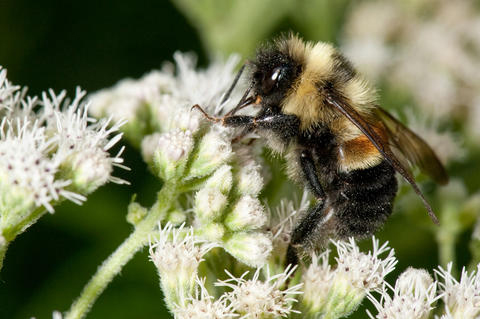
Above: The Rusty Patched Bumblebee. Photo Heather Holm, University of Minnesota.
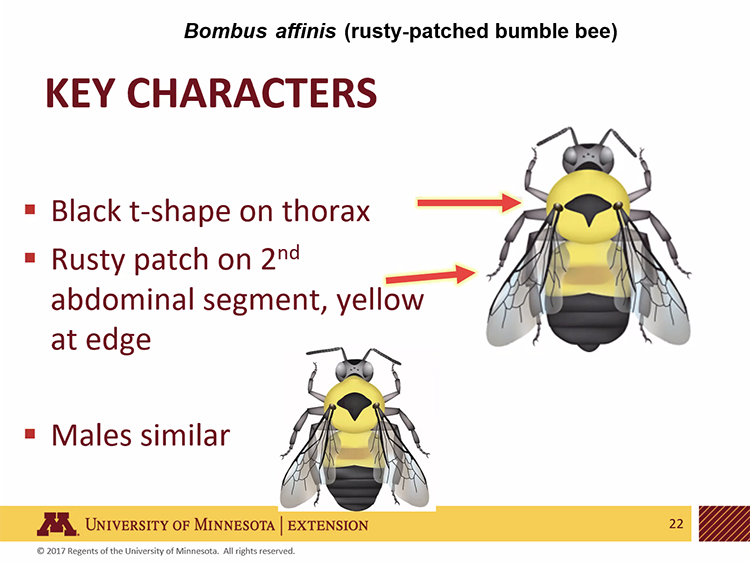
They nest in the ground and in cavities. The males and workers have two distinguishing identifying marks:
1. There is a T-shaped area of black hairs on the thorax and
2. There is a rusty colored patch in the middle of the 2nd abdominal segment.
The Queens have different identifying marks and they usually lack the rusty patch.
The University of Minnesota Extension Division, particularly via etymologist Elaine Evans, has led research into the life of this bee.
Below: Thanks to the University of Minnesota Extension for the use of their Identifying Chart.