
These short articles are written to highlight the plants, history and lore of the Eloise Butler Wildflower Garden to past and contemporary events and may include personal commentary of the writer, not necessarily related to the Wildflower Garden. A web of present and past events.
November/December 2025
Articles
Update to the Wildflower Garden entrance
Wood Vaulting - Carbon storage, not gymnastics
Planting guide for the loosestrifes
Garden entrance renovation
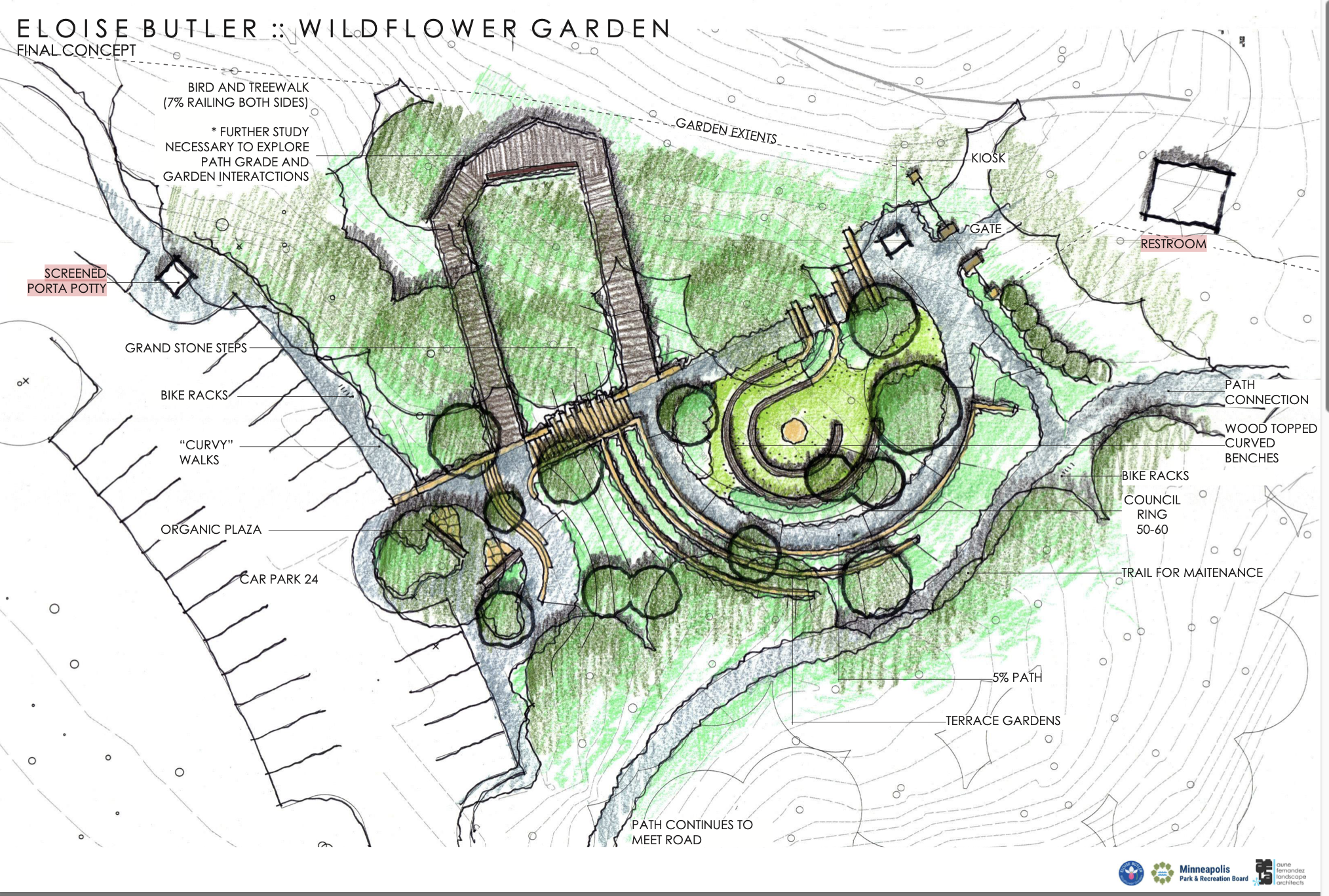
The Minneapolis Park and Recreation Board (MPRB) is in the planning stages for a major renovation of the entrance approach to the Wildflower Garden. This will be the first real change to this area since the steps were put in during 1975 and the current front gate constructed in 1990.
The purpose of this is outlined in the following MPRB project plan:
The Eloise Butler Wildflower Garden Entrance Renovation Project looks to renovate and reimagine the entrance into the wildflower garden. This project will improve the entry experience and access from the beginning as soon as visitors exit off Theodore Wirth Parkway all the way through the garden gates. Areas of focus include:
1. Improved walking trails and ADA access to the garden entrance gate from the existing parking lot.
2. A public gathering space for outdoor learning and education.
3. Enhanced welcoming experience by bringing the garden beyond the renovated entrance gate.
The Eloise Butler Wildflower Garden Renovation Project will build upon the vision outlined with the 2015-approved Theodore Wirth Regional Park Plan. This project will also follow guidance by the 2022 community findings that were developed and recommendations at that time.
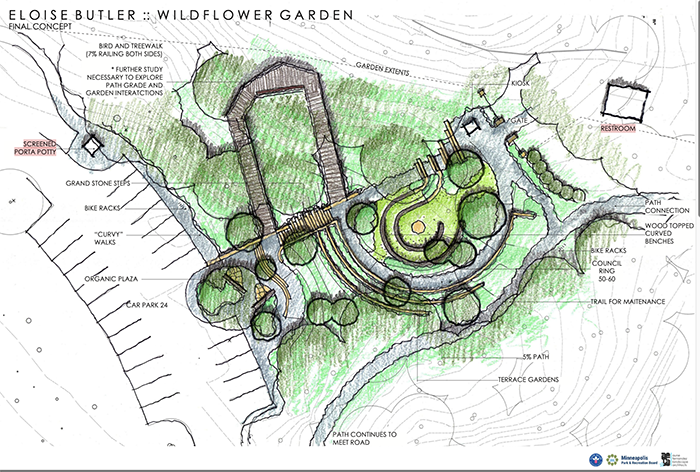
Below: Drawing of the entrance renovation design - courtesy Minneapolis Park & Recreation Board.
[Larger image]
Two public meetings, an on-line survey, and an open house were held for interested parties to comment.
The MPRB planners have had two meetings with the Friends board of directors to review the project and receive our comments. We will continue to be involved as this project moves toward the final stages.
For details and updates on this project please visit the Wildflower Garden section of the MPRB web site.
Wood Vaulting
How to remove 12 billion tons of carbon dioxide from the atmosphere every year - a concept many have not heard of.
The concept is simple:
Divert materials from the biological carbon cycle into the much slower geological carbon cycle. How? Go back to something that has happened in nature for millennia - bury it.
Below: Fire killed trees being gathered at a site in Montana for burial. Photo - Grist.org.

Some of the flashier ideas of removing carbon dioxide from the atmosphere such as direct air capture, require vast efforts and miles of pipeline to achieve scale and are not making headway. The leading advocate of wood vaulting is Ning Zeng of the University of Maryland. He states “Every year, terrestrial plants alone capture six times as much carbon as our fossil fuel emissions but pretty much all of that goes back into the atmosphere as leaves fall and trees die and decay.”
It is projected that it would only take a small fraction of the wood that decays above ground to be buried to achieve the amount of carbon removal estimated by the United Nations Panel on Climate Change to achieve the goal of keeping the planet’s temperate rise to less than 2 degrees. Think of all the wood debris that results for tree harvesting, sawmill operations, landfilling, tear-downs, etc.
Is it being tested?
Yes. The first known commercial project is operational in Colorado, collecting leftover debris from logging. In Montana, Mass Reforestation has buried the remains of trees from wildfire areas.
Below: 10 million pounds of fire killed trees loaded in a burial chamber. Photo - Mast Reforestation.

What’s the catch?
The buried wood must not decay rapidly and release all that buried carbon back into the atmosphere. That means the intrusion of water and oxygen must be limited. Multiple layers of stacked wood can be put into a single hole, but the hole should be in clay or silty soil away from groundwater. The area must then be monitored by sensors like those used for landfills. Digging a large hole is also disturbing to the landscape, so ideal sites are those already compromised and degraded.
Below: Excavators are used to dig pits and layer the trees. Photo - Grist.org.

It is not totally clear how long such vaults will store the carbon but an example comes from Canada where the firm Carbon Lockdown found in one its digs a cedar log deeply buried that was confirmed to be about 3,700 years old and had lost only 5% of its carbon.
The concept is being researched by a number of Universities including Maryland, Cornell, and Cal State, along with the US Forest Service and interested parties funding research into it, include the US Department of Energy, and investors such as Bill Gates.
Planting guide for the Loosestrifes

If you pick and choose wisely, the loosestrife family has a species for everyone and everywhere - sun, shade, wet. The colors are primarily yellow with a few pink, usually 5 petals but all loosestrifes can occasionally have extra petals. Most plants grow to two feet or more in height. The Eloise Butler Wildflower Garden is graced with examples in all 3 habitats. All however, require certain amounts of moisture and are not recommended for dry upland environments.
All the recommended species are native to Minnesota but vary in flowering times. Most are available from native plant suppliers as plants or seeds.
For light shade you have one good choice with fringed loosestrife (Lysimachia ciliata) which is indigenous to Eloise Butler Wildflower Garden. The flowers are on long stalks from the upper leaf axils. It will also grow in full sun if it has plenty of moisture. "Fringed" refers to fine hairs on the stem nodes and leaf stalks of the lance shaped leaves. It is usually found along violet way in the woodland in the Wildflower Garden where it blooms from early to late summer.
For upland sunny habitats with adequate moisture, the whorled loosestrife (L. quadrifolia) is beautiful and so named as the leaves, wedge shape to rounded, are in a whorl, usually of 4. This species is special to the Wildflower Garden as it is rare in Minnesota and on the state special concern list, but it likes the Garden’s habitat as it has grown in large numbers in the Upland Garden, particularly on Aspen Alley. The long-stalked flowers spring from the upper leaf axils, also in whorls, and have a very showy reddish band at the base of the stamens. It flowers from early to late summer.

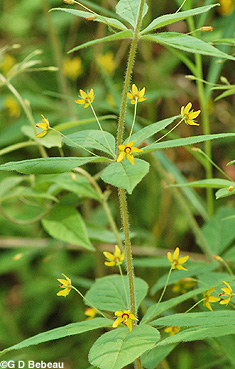


Another upland candidate is prairie loosestrife (L. quadriflora), also called “4-flowered loosestrife” because flowers can form in a whorl in groups of 4. One drawback can be the thin stem. It can be overpowered by larger neighbors and lean unless it has an adequate moisture source. The petal tips are more ragged than fringed loosestrife but have a similar point to the tip. Leaves are long but only 1/4 inch wide. It comes into flower in mid-summer.

For wet environments you have three choices: tufted loosestrife (L. thyrsiflora), swamp candles (L. terrestis) and winged loosestrife (Lythrum alatum). These do not mind wet feet as long as it is sunny. Swamp candles has that reddish band at the base of the stamens but, unlike the others noted here, the yellow flower many times has more than 5 petals. The flowers are in a raceme atop the stem, not rising individually from leaf axils. It blooms in early summer and usually grows to 3 feet.


The tufted loosestrife (L. thyrsiflora), also indigenous to Eloise Butler, has an all together different appearance. While the flowers spring from the leaf axils, they are small and grouped into a compact egg shaped inflorescence called a thyrse. These rise from the middle stem leaf axils. Once you see it you will confuse it with other loosestrifes. The leaves are opposite, long and narrow. Flowering is late spring to early summer.

The third wetland choice is also for the most moist areas, winged loosestrife (L. alatum). You may have noted above is in a different genus - Lythrum. The flowers are lavender to rosy pink, in the leaf axils but not on long stalks. It prefers the edges of wetland and riparian areas and adds a different color to the landscape as it blooms in early summer. This is a sturdy plant, taller than the others.
Do not confuse winged loosestrife with its cousin introduced from Europe as an ornamental, purple loosestrife (Lythrum salicaria), which is one of the most invasive plants in North America and has been on the Minnesota Prohibited Control Noxious Weed List for the last 33 years. Purple loosestrife shares the same habitat but flowers in late summer. You will not fine it in the Wildflower Garden but it is easily found around the metro area in marsh habitats. ❖


History in 25 years slices
We go back 100 years to 1925 and then move forward in 25 year bits.
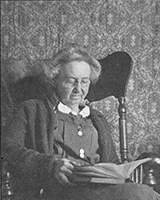 Eloise Butler usually made her late fall journey to Malden MA by train, but in 1925 she rode in her cousin’s car to Indianapolis for a four day visit and wrote to Martha Crone “My cousin’s automobile didn’t skid over a precipice, as I though it might.” In the same letter she gave her recipe for prize-winning Quince and Cranberry jam. (pdf of letter).
 Martha Crone in 1950 was rather diplomatic about her lack of help in the Wildflower Garden when she wrote to Superintendent Charles Doell “The greater number of visitors demanded more service, yet with greatly curtailed assistance it was difficult to complete projects under taken.” This was preceded by "Judging by the great number of visitors who come to the garden repeatedly, it is a feature of great interest to thousands of students and nature lovers from not only Minneapolis and the State of Minnesota, but also from other states. Something close to home is taken for granted until the remark of a stranger brings true value into focus."
The truth of her remark became clear after the Martha Crone Shelter opened in 1970 and the Friends placed a guest book on the Shelter table. The places and countries that visitors came from were astounding. The Fringed Gentian™ frequently had notes about the visitors, some rather will known, such as Fromer President Jimmy Carter (1988) or Mrs. Douglas Campbell and Lady Judith Guthrie of the Guthrie Theater (1967).
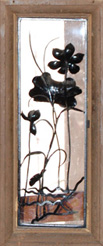
If we skip forward 25 years to 1975, the Friends made an inventory of items in the Crone Shelter for insurance purposes, as the Friends provided the insurance at that date, and outside of the large oak table the most highly valued item was the four volume set of Birds and Trees of North America at $400. They are rare today in any edition and usually for far more dollars. Another item in the insurable inventory was the wrought iron sculpture work that is set into the door of the Shelter, valued at $50 and by no means replaceable today at that price.
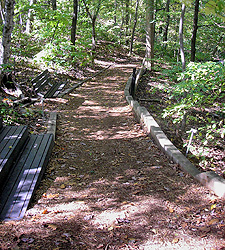
Our final 25 year slice is the year 2000, when the Friends funded renovating the trail from the front gate to the Crone Shelter. We noted in the April 2025 Twigs and Branches that it was 25 years previous that the path trail was put in. The 2000 update has weather the past 25 years and may have a few more useful years to go. The Friends also funded in 2000 the 3 benches in patio area of the Shelter which the MPRB recently renovated with new wood.

For a last surprise we have a photo of one of the Garden naturalists in 2000 using the spotting scope on the old wetland bridge. She has recently returned to a naturalis position and has been shelter volunteer coordinator this past year.
Historical Photo
The Garden wetland with a grove of birches 74 years ago, from a Kodachrome by Martha Crone on November 8, 1951. Photo ©Friends of the Wildflower Garden.
