The Friends of the Wildflower Garden Inc.
Trees & Shrubs of the Eloise Butler Wildflower Garden
The oldest public wildflower garden in the United States

Common Name
Black Chokeberry
Scientific Name
Aronia melanocarpa (Michx.) Elliot
Plant Family
Rose (Rosaceae)
Garden Location
Woodland
Prime Season
Spring - May flowering, mature fruiting in September
Black Chokeberry is a native deciduous woody shrub growing from 3 to 12 feet high.
Twigs of new wood are green initially, turning reddish with age and finally purplish-brown on old stems. Twigs are hairless, with long terminal and lateral buds that have several large scales. The lateral buds form the short stub twigs on which the flower cluster arises.
Leaves are alternate, ovate-lanceolate shape with a short stalk, fine toothed edge, hairless, medium green color which turns a dark glossy green in the autumn before finally turning red. The midrib on the upper side has dark red stiff glands.
The inflorescence is a terminal panicle on the tips of short stub twigs rising from buds of the prior seasons growth. Flower clusters will be 2 to 2-1/2 inches wide.
Flowers are 5-parted, showy, around 20 stamens with pink to purplish red anthers and with a 5-parted style, all rising from a yellow-green central receptacle. The 5 white petals have narrowed bases (clawed). The hypanthium is light green in color, cup shaped with 5 sepal lobes that are triangular in shape. Flower buds appear with the new leaves.
Fruit matures in the autumn to a juicy purplish-black berry, (a pome) about 1/4 to 1/3 inch in diameter, that once ripe, begins to shrivel. Each pome contains 1 to 5 elliptically shaped seeds, each about 3.5 mm long. Seeds and juice are deep purple. Fruit usually drops from the plant but a number of pomes will overwinter as they are not the most palatable to wildlife except birds. Deer however, will browse the plants. The berries are very astringent and most people cannot eat them raw. Humans can use the fruit for canning and jelly making. When cooked, Chokeberries make a heavy, sweet, solid jelly. They have an abundance of pectin and should self-set. The antioxidant qualities of Chokeberry make them very beneficial for the human diet.
Habitat: Black Chokeberry grows best in full sun on moist well drained sites. It is tolerant of some shade. Several cultivars are available in the nursery trade, some of which are from European stock, so care must be taken if you wish a pure native species.
Names: Some references have transferred this plant into the genus Photinia although many references will insist it remain in Aronia and apparently, recent molecular data would support that conclusion. (##ref below). Minnesota authorities - the DNR and the U of M Herbarium are using Aronia, as is the authoritative Flora of North America which just published (2016) the new volume on the Rosaceae. The genus Aronia is derived from the Greek aria, which is a Greek name for a species of Sorbus whose fruits resemble Chokeberry. The species, melanocarpa, is from two Greek words - melas, meaning 'black' and karpos, meaning 'fruit,' together that mean 'dark fruit.' In even earlier times the plant was classified as Pyrus melanocarpa.
The author names for the plant classification are twofold: First to classify was - “(Michx.)” which refers to Andre Michaux (1746-1802), French botanist who made many exploring expeditions in the U.S. collecting and cataloging many species. Two important works of his are the Histoire des chênes de l'Amérique septentrionale (1801 - Oaks of North America), and the Flora Boreali-Americana (2 vols., 1803). His son Francois, traveled with him and the father’s notes were later used for the 3-volume North American Sylva. Michaux's work was amended by ‘Elliot’ which is for Stephen Elliot (1771-1830) American botanist and collector whose herbarium was the largest in America at the time. He is noted for A Sketch of the Botany of South Carolina and Georgia. The alternate genus Photinia, is from the Greek photeinos meaning 'luminous' and is used here with plants with glossy leaves.
Compare: A similar plant is Red Chokeberry, Aronia arbutifolia, whose leaves are slightly larger, hairy initially, and the fruit is red.

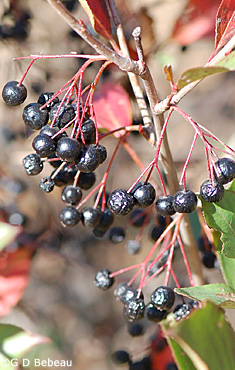

Above: 1st photo - Black chokeberry flowers. 2nd photo - autumn fruit begins to shrivel once ripe. 3rd photo - Leaves in autumn turn a dark glossy green before becoming red. There are dark red glands on the upper midrib.
Below: 1st & 2nd photos - New leaves and flower buds appear at the same time. 3rd photo - In the 5-parted flower you can see the clawed petals, some of the anthers still pink.


Below: 1st photo - Old stems have a purplish-brown color. 2nd photo - A grouping of Black chokeberry with fruit in late-summer, plants about 5 feet high.


Below: 1st photo - A spring twig showing the long buds just before leaf emergence. 2nd photo - The cup-shaped hypanthium with 5 pointed lobes.


Below: 1st photo - Green fruit forming in June to early July. Green fruit resemble tiny apples. 2nd photo - Each berry contains from 1 to 5 elliptically shaped purple seeds.


Below: 1st photo - The young leaves of early summer form a cluster of the ends of twigs. 2nd photo - The midrib on the upper side of the leaf has dark red stiff glands.


Notes: Black Chokeberry is indigenous to the Garden. Eloise Butler noted finding it in the Garden on May 28, 1910. She also planted the shurb in 1925 and '27 using the name of Aronia melanocarpa. Her last additions were in 1931 when she used the Photinia genus, as did Martha Crone when she planted it on June 1, 1933 with plants obtained in Anoka, MN, and then again in 1949. Gardener Ken Avery planted it in 1964, but then it was not listed on the 1986 Garden census, but has been replanted, as recently as 2008. Black Chokeberry's range in North America is from Minnesota southward and east to the coast with the exception of LA and FL. In Canada - from Ontario eastward. Within Minnesota it is found in the NE corner down to and thru the metro counties of Hennepin, Ramsey, Dakota, Washington and Anoka. Rare elsewhere.
This is the only species of Aronia native to the state and one the only two species in North America.
## Ref. Campbell, C.S.; Evans, R.C.; Morgan, D.R.; Dickinson, T.A.; Arsenault, M.P. (2007). Phylogeny of subtribe Pyrinae (formerly the Maloideae, Rosaceae): Limited resolution of a complex evolutionary history. Plant Systematics and Evolution. 266(1–2): 119–145
Return to -- Site Plan/Archive Index --or-- List of Common Plant Names -- or -- List of Scientific Names -- or --Home Page - - - Back to top.
References: Plant characteristics are generally from sources 1A, 32, W2, W3, W7 & W8 plus others as specifically applied. Distribution principally from W1, W2 and 28C. Planting history generally from 1, 4 & 4a. Other sources by specific reference. See Reference List for details.
 Identification booklet for most of the flowering forbs and small flowering shrubs of the Eloise Butler Wildflower Garden. Details Here.
©2013
Friends of the Wildflower Garden, Inc. Text and photos are by G D Bebeau unless otherwise credited. "www.friendsofeloisebutler.org"
082622