The Friends of the Wildflower Garden Inc.
Trees & Shrubs of the Eloise Butler Wildflower Garden
The oldest public wildflower garden in the United States
Common Name
Kentucky Coffeetree
Scientific Name
Gymnocladus dioicus (L.) K. Koch
Plant Family
Pea (Fabaceae)
Garden Location
Woodland
Prime Season
Spring flowering, seed pods in Autumn lasting to following spring.
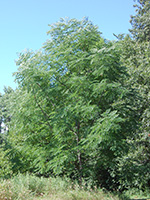
Kentucky Coffeetree is a tall native deciduous tree, up to 80 feet high, with a narrow open crown.
Twigs are stout, light brown with white spots. Leaf scars are heart shape. Buds are hidden until leaf-out. So - it appears to be dead when it is not in leaf as the buds do not swell until ready to leaf-out and then it leafs out late providing an extra month of a 'dead-tree' look compared to neighboring maples, oaks and ashes.
The bark of mature trees is a gray-brown and has a somewhat scaly appearance with sharp edges. Young bark becomes scaly very early with brown tones between the scales.
Leaves are large, alternate and bi-pinnately compound, 12 to 30 inches long, with up to six pairs of branchlets, each with numerous 1.5 to 2 inch ovate leaflets. This represents the largest leaves of any native North American species. No teeth on the leaflets, paler color on the underside. Yellow fall color.
Flowers: Kentucky Coffeetree is dioecious, that is, male and female flowers are on separate trees. In the late-spring appear the small, bluish-white, individually stalked flowers, arranged in a long terminal raceme, up to 6 inches long, and quite striking in color. The calyx is purplish with 5 narrow and long pointed teeth which shade to a whitish-green color. These teeth (the sepals) are almost as long and alternate with the 5 white petals which are wider and less pointed and broader near the tip. All these parts have fine hair. The stamens of the male flowers have yellow anthers and cluster in a pillar shaped group as tall as the petals are long. The receptacle of the female flowers is concave with a stout headed style. It too is as tall as the petals are long. The sepals and petals spread outward when the flower opens and do not resemble the typical pea family flower which usually has a banner petal, two laterals and two forming an enclosed keel.
The autumn fruit is a large (4 to 7 inch long, 1 to 2 inch wide) thick dark red-brown pod that usually stays on the tree over winter, but if it drops in autumn, it does not open at that time to disperse the seeds, but remains closed during the winter. The seeds are 3/4 inch bean-like rounded seeds, usually 4 per pod, but up to 6, that are embedded in a sticky pulp. Seeds in the spring can easily be germinated and planted but the seeds should be scarified first. Animals avoid the seeds and the leaves as they contain the toxic alkaloid cystisine.
Habitat: It is a superior tree for the home landscape as it is not known to be susceptible to disease or insects in this area. Full sun and moist soil is best for this tree.
New Cultivar: In 2016 the University of Minnesota Arboretum introduced "True North", Gymnocladus dioicus UMNSynergy. It is bred to be male only, denser branching with a compact oval crown. At maturity it is to reach 75 high with a 30 foot spread.
Names: The generic name, Gymnocladus, is from two Greek words, gymnos, meaning 'naked' and klados, meaning 'a branch' and refers to the appearance of the tree when not in leaf. The species name, dioicus, means 'of separate houses' and refers to the flowers being of a single sex on each tree. Other Gymnocladus species have bisexual flowers. The author names for the plant classification are as follows: First to classify was '(L.)' which refers to Carl Linnaeus (1707-1778), Swedish botanist and the developer of the binomial nomenclature of modern taxonomy. His work was amended by ‘K. Koch’ which refers to Karl Heinrich Emil Koch (1809-1879), German botanist, Professor of Botany, first professional horticultural officer in Germany, plant collector in and near Asia Minor. The common name comes from the seeds which were an early coffee substitute when roasted but are considered somewhat poisonous (as are the leaves) when not roasted. (Roasting neutralizes the toxin). More notes below.


Above: 1st photo - The pure form of a younger specimen of Kentucky Coffeetree, unconfined by other trees in early spring with the prior year's pods still attached; 2nd photo - in summer, in full leaf - 3rd photo - Fall leaf color.
Below: 1st photo - The stout twig with buds breaking and showing the typical whitish spots. 2nd photo - The flower raceme prior to flower opening. 3rd photo - The large twice compounded leaf. 4th photo - young bark - already scaly with brown under tones.


Below: 1st photo - The bark of mature trees is furrowed and has a slightly scaly appearance. 2nd photo - A number of seed pods will persist overwinter on the tree and drop the next spring. As the tree leafs out late, this causes the tree to have a dead appearance in Spring.


Below: 1st photo - The male flowers opening on the large raceme. 2nd photo - The seed pod of the tree.


Below: 1st photo - A male flower. 2nd photo - A female flower. Note the petals of the flowers are broader and slightly longer than the sepals.


Below: 1st photo - The purplish calyx shades to greenish white at the tips of the long pointed sepals. 2nd photo - The 3/4 inch rounded seeds found in the pod.


Below: New seed pods formed by mid-summer are a yellow-green in color before turning brown-black.


Below: One of the mature trees in the Eloise Butler Wildflower Garden, woodland garden. This specimen is a member of a grove of such trees. Drawing from Francois Michaux, North American Sylva, Robert Smith, Philadelphia, 1855 edition, volume 1.


Below:Looking up into the canopy of one of the old Coffeetrees at Eloise Butler.

Below: My Kentucky Coffeetree in 2018, six years old, started from seed. Story below.

Notes: Kentucky Coffeetree first made it's appearance in the Garden in May 1909 when Eloise Butler planted some selections received from the Park Board. Martha Crone planted 36 small ones in 1934 that had been acquired the previous fall and heeled in for the winter. Additional plants came in 1949. A number of these still are growing in the Woodland Garden in the vicinity of Guidebook Station 10 and also along Violet Way. It is native to Minnesota in some south central counties and several counties in the SE near the Mississippi River. In North America it is found from the central plains states eastward, absent in NH, FL, VT and LA. In Canada it is only known in Ontario. In all places, wild populations in modern times are extremely rare.
Rarity: Wild populations were not found in Hennepin County where the Garden is located but it has been extensively planted in private and public landscapes. In the wild today in Minnesota it's habitat is becoming critical and the plant is now listed on the Minnesota DNR "Special Concern" list.
In 1975 in The Friends Newsletter, The Fringed Gentian™, Mr. Gordon Morrison, Coordinator of Environment Education for the Minneapolis Park Board wrote this:
“Over the last century the Park Board has planted a number of these interesting trees throughout the city. Most parks have at least one of them. The largest of these are two Kentucky Coffeetrees growing on either side of Minnehaha Creek just upstream from the point where Lake Nokomis flows into the creek. They are very slow growing here in the North. They may grow quite rapidly their first four or five years but then slow down to an almost unperceivable growth rate from then on. Those two near Lake Nokomis are only about one and a half feet in diameter though they are probably as much as seventy years old. Presumably those planted in the garden were planted many decades ago, perhaps by Miss Butler.”
Substitute for Coffee: It was not a good tasting beverage. Botanist Francois Michaux (Ref. #26b) wrote, in his North American Silva of 1819: "The name of Coffee Tree was given to this vegetable by the early emigrants to Kentucky and Tennessee, who hoped to find in its seeds a substitute for coffee; but the small number of persons who made the experiment abandoned it, as soon as it became easy to obtain from the seaports the coffee of the West Indies." He further writes: "The Coffee Tree was sent to France more than 50 years since. It thrives in the environs of Paris, where there are trees that exceed 40 feet in height, but it does not yield fruit, and is multiplied only be shoots obtained by digging trenches round the old trees. The divided roots produce shoots 2 or 4 feet long, the first year. The young trees are sought, on account of their beautiful foliage, for the embellishment of parks and pictoresque (sic) gardens."
My Kentucky Coffeetree
All that is required to grow the tree is a seed, space and patience - especially the latter. Wait till Spring and find one of the seed pods that has overwintered on the tree or on the ground below the tree. The seeds will be ready to germinate. There are usually 4 to 6 seeds per pod embedded in a sticky pulp. Most critters avoid eating the seed as they contain a toxic alkaloid called cystisine, so its not hard to find pods. Find an open space where the tree has room to grow. The 3/4 inch seed, should be scarified and just-covered with soil, watered and put a little fence around it. I started mine in a small pot, which requires planting in the ground by Autumn or the root development will be hindered.
Now comes the patience part. Some say the tree is fast growing at first then it slows down; commentary that is dependent on the interpretation of what's fast and what's slow. In Spring 2018 my tree had been in the ground six years and it was seven feet high. It looked nice when it had those large compound Summer leaves but after leaf-fall it was just a stick, that is, until year six when I saw near the top of the stick a short stub. Finally a branch! Yes, in year six several leaves developed on the stub and now it begin to look like a real tree - sometime - as after leaf-fall I still had a stick, but with a stub near the top below the new growth that occurred that year. In year seven it developed two more stubs and the first stub had several leaves. New growth at the top was almost 3 feet, so now it is 10 feet high at the end of 2019. Now into the future! I wonder what sex it is - will it be female and have fragrant flowers and maybe get pollinated from some male in a near-by park and make seeds? or will it be male and just have flowers? I will never know. Most deciduous trees require decades before flowering and bearing fruit. Maybe the next steward of my plot of land will find out - or the person after that - but hopefully the tree will survive and add another touch of interest to the landscape. Meanwhile, I've started two more from seed.
Return to -- Site Plan/Archive Index --or-- List of Common Plant Names -- or -- List of Scientific Names -- or --Home Page - - - Back to top.
References: Plant characteristics are generally from sources 1A, 32, W2, W3, W7 & W8 plus others as specifically applied. Distribution principally from W1, W2 and 28C. Planting history generally from 1, 4 & 4a. Other sources by specific reference. See Reference List for details.
 Identification booklet for most of the flowering forbs and small flowering shrubs of the Eloise Butler Wildflower Garden. Details Here.
©2014
Friends of the Wildflower Garden, Inc. Text and photos are by G D Bebeau unless otherwise credited. "www.friendsofeloisebutler.org"
011425