The Friends of the Wildflower Garden, Inc.
Trees & Shrubs of the Eloise Butler Wildflower Garden
The oldest public wildflower garden in the United States

Common Name
Swamp White Oak
Scientific Name
Quercus bicolor Willd.
Plant Family
Beech (Fagaceae)
Swamp White Oak is a native deciduous tree growing to almost 100 feet tall, usually with an irregularly shaped crown due to confining conditions but in the open it can have a very nice rounded vase shape at maturity. Young trees will have a more pyramidal shape. The largest known Swamp White Oak in Minnesota is in Chisago County, measuring 60 feet high, 140 feet in crown spread, 141 inches in circumference and scoring 236 points. By contrast the National Champion is in Somerset, NJ - 105 feet high, 102 foot spread, 268 inches in circumference, scoring 399 points.
Bark is gray but scaly on young wood which is distinctive for the species. Old wood forms ridges and fissures.
Twigs are light brown in color, smooth, with short blunt terminal buds that are light to dark brown in color.
Leaves are 3 to 7 inches long, ovate with a triangular or narrow wedge shape base and with a rounded point at the tip. The edges are not deeply cut like some other oaks but with broad large teeth, either on the entire leaf or just the top half. There can be many variations between trees and on the same tree. The secondary veins (laterals) are slightly arched. The upper side of the leaf is a dark shiny green and the underside much lighter, more whitish, with dense fine hair, which is why the species name is bicolor. Fall color is yellow to rusty brown - not considered striking.
Flowers: The tree is monoecious, that is with separate male and female flowers. The male flowers are yellow-green drooping catkins occurring at the tip of last year's twig. Each male flower has six stamens (can very from 2 to 12), which have long spreading white filaments when the flower fully opens. The female flowers are more reddish-green and appear as small slender spikes in the leaf axils of new growth. The styles are slender and short. Both appear with the leaves.
Seed: Female flowers develop into long stalked acorns. The long stalk is a distinguishing characteristic of this species. The cup-like covering of the acorn covers 1/3 to 1/2 of the bottom of the acorn. The cup has small leafy filaments that drop away as the acorn develops. Once formed, the cups do not enlarge much compared to the acorn. The acorn turns light brown and matures in late summer into autumn of the first year as do most species in Quercus Sect. Quercus - the White Oak Group. Pairs of acorns are not uncommon. They can germinate immediately on falling from the tree. Dispersion is by animals. Trees require some age before bearing - upwards of 20 years.
Habitat: Swamp White Oak grows best in full sun in moist acidic soils. The MN Landscape Arboretum reports that it will grow better if the site is well drained. The tree does not develop a deep taproot like other oaks and thus is somewhat easier to transplant. Like most oaks, this species is highly variable. Swamp White Oak will hybridize with Bur Oak and White Oak, particularly Bur Oak where hybrids will have more deeply lobed leaves and variations of fringes developing on the acorn cup.
Names: The genus name, Quercus, is the Latin word for Oak. The species, bicolor, refers to the contrasting color of the upper and lower sides of the leaf. The author name for the plant classification, from 1801, - ‘Willd.’ is for Carl Ludwig Willdenow (1765-1812), German botanist, a founder of the study of the geographic distribution of plants. He was director and curator of the Botanic Garden of Berlin.
Comparisons: White Oak, Q. alba is very similar but the acorns do not have these long stalks and the leaves are not whitish on the underside. Check the Oak Leaf Comparison sheet.


Above: Younger trees will have a more pyramidal shape, similar to the way other White Oak species develop, eventually forming a rounded crown as seen below. Leaf and acorn drawing courtesy Flora of North America
Below: 1st photo - This Swamp White Oak growing in uncrowded space, has a nicely shaped rounded crown. Young trees are pyramidal as seen above. 2nd photo - The scaly bark of Swamp White Oak is noticeable even in very young examples. 3rd photo - Older trunks develop fissures and ridges.


Below: Male flowers develop in drooping yellow-green catkins rising from the tip of last year's growth. Individual flowers (2nd photo) are clustered along the catkin. 3rd photo - Female flowers on short stalks in the leaf axils of new growth.


Below: 1st photo - Leaf shapes vary - see more below. 2nd photo - Twigs have blunt short buds. 3rd photo - Acorns usually develop singly, sometimes in pairs. The cup has small leafy filaments that drop away as the acorn develops.


Below: Acorns - as the acorn matures the cup will only cover 1/3 to 1/2 of the acorn. In the first photo note the characteristic long stalk of the acorn as it develops. Acorns mature in the first year.


Below: Two additional variations of leaf shape. Note the glossy dark green upper leaf surface and the triangular base of the leaf.


Below: The underside of the leaf is much lighter in color that the upper due to fine whitish hair, which is the source of the species name 'bicolor'.


Notes: In North America Swamp White Oak's range is Ontario, Minnesota, Iowa and Missouri on the west and then eastward to the coast, the southern tier of states excepted. In Minnesota, its range is quite limited - Stearns, and the metro area counties from Hennepin eastward are the northern edge with the Mississippi River counties of Goodhue, Wabasha, Winona and Houston being the primary locale in Minnesota. Also noted in Dodge, Waseca, and Yellow Medicine Counties.
As to the Garden, Eloise Butler introduced the first one in April 1917 when she obtained some stock from Kelsey's Nursery in Boxford Mass. She listed it as var. plantanoides, which is now one of three old varieties now combined under Q. bicolor. She also noted the tree on September 9, 1921 when she determined that several trees in the Garden were Q. bicolor when she had previously thought they were Q. alba. If the tree was already in the Garden, why, in November 1923 when Eloise was in Malden MA for the winter, did she write to Martha Crone that she was sending Martha some swamp white oak acorns and could Martha snoop around the cities to see if she could find tree? Was she forgetful or were those mis-identified trees not swamp white oak after all?
Whatever those trees were, they died out at some point and the species was not listed on the 1951 Garden census. Martha Crone planted the species in 1958. Susan Wilkins has replanted the tree as recently as 2017.
Due to habitat pressure, the tree is currently listed on the DNR's list of Minnesota Rare Plants in the "Special Concern" section. But with the 2023 revision of habitat zones by USDA it is more likely the tree will move further north as the metro is now considered zone 5b. Furthermore, estimates of the U S Department of Agriculture’s Northern Forests Climate Hub, made from modeling either low amounts of climate change or high amounts of change, indicate that by 2100 Swamp White Oak will increase its forest biomass by over 20%.
Native Oaks: The current native oaks in Minnesota are 6: Q. alba, White Oak; Q. bicolor, Swamp White Oak; Q. ellipsoidalis, Northern Pin Oak; Q. macrocarpa, Bur Oak; Q. rubra, Northern Red Oak; Q. velutina, Black Oak. One other is historical - Q. muhlenbergii, Chestnut Oak, known only from Houston County and last collected in 1899. Several hybrids are historically known. Several others grow well here under certain conditions such as Q. palustris, Pin Oak; and Q. coccinea, Scarlet Oak.
Uses: The wood is similar to White Oak (Q. alba) but there is much less of it grown and it is often very knotty as the species does not self prune its lower branches as Q. alba does. Swamp White Oak lumber therefore is commonly used as a secondary wood in furniture and for more mundane things like crates, posts, general construction material.
It is not too difficult to visually identify a piece of oak lumber as from the White Oak Group but more difficult to separate a specific species from the other members of the White Oak group. There are clear contrasts with the Red Oak group. In the White Oaks the tallest of the largest rays are greater than 1-1/4 inches and the latewood has numerous small pores that grade into invisibility, whereas the Red Oak group has the tallest rays less than 1 inch and the latewood pores are few and more distinct. A small hand lens is necessary to see this clearly.
Return to -- Site Plan/Archive Index --or-- List of Common Plant Names -- or -- List of Scientific Names -- or --Home Page - - - Back to top.
References: Plant characteristics are generally from sources 1A, 32, W2, W3, W7 & W8 plus others as specifically applied. Distribution principally from W1, W2 and 28C. Planting history generally from 1, 4 & 4a. Other sources by specific reference. See Reference List for details.
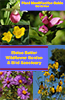 Identification booklet for most of the flowering forbs and small flowering shrubs of the Eloise Butler Wildflower Garden. Details Here.
©2015
Friends of the Wildflower Garden, Inc. Text and photos are by G. D. Bebeau unless otherwise credited. "www.friendsofeloisebutler.org"
120723