Plants from Isle Royal
The Curators stock the Wildflower Garden
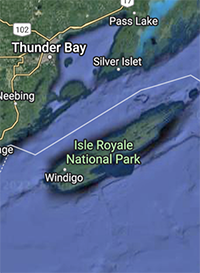
In the days of the first two curators of the Eloise Butler Wildflower Garden, Eloise Butler and Martha Crone, a number of rare plants from Isle Royale were added to the Garden. The first mention of this source was in Butler’s 1920 and 1921 Garden Log when she planted False Toadflax (Geocaulon lividum) and Devils Club (Oplopanax horridus, details below).
She did not list who provided these but my guess it was her friend Gertrude Cram who was listed as the source of all later plants from Isle Royale. Mrs. Cram went to Isle Royale most summers in August staying at Rock Harbor Lodge and sent back plants for the Garden. She was one of the first persons to congratulate Martha Crone on assuming the Curatorship when she wrote on April 23, 1933:
“I have heard so much of you from Miss Butler that you seem like an old acquaintance. I am so glad to hear that you are to be in her beloved garden in her stead. - I trust for more than temporarily - for I am sure it is what she would have desired.”
Most of these plants of the north were either rare or not existant in Minnesota, so they fulfilled a desire of Eloise and Martha to plant whatever may be suitable for the local habitat to see if they could grow here. Most of course, were too far south and did not survive long term, but some did last well into the 1960s.
Mrs. Cram would mail the plants back to Minneapolis from the Island. An example of her humorous writing is the following from August 8, 1933:
“By the Wednesday boat I am sending you a box of things, a funny one. It contains a sample of a number of plants of which you may or may not want more. ... This is what Miss Butler used to call a ‘surprise’ package, I am sure. The tall yellow things on top of the box is (sic), I think, Lysimachia terrestis, (Swamp Candles) which Miss Butler asked for last year. The roots go to China. I don’t think I got much, for as I was groveling in the muck among sticks and roots I couldn’t seem to feel the ends of the ones I was blindly following.”
A list of the various plants from Isle Royale sent to the Garden over the years of the 1930s, other than those mentioned, includes:
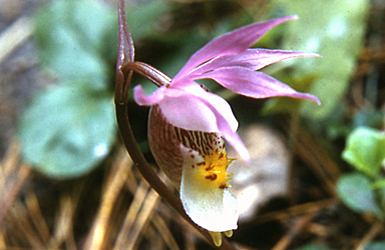
Calypso Bulbosa, Fairy Slipper Orchid
Cryptogramma acrostichoides, American Rock Brake Fern
Dryopteris fragrans, Fragrant Fern
Gaultheria hispidula, Creeping Snowberry
Geranium carolinianum, Carolina Geranium
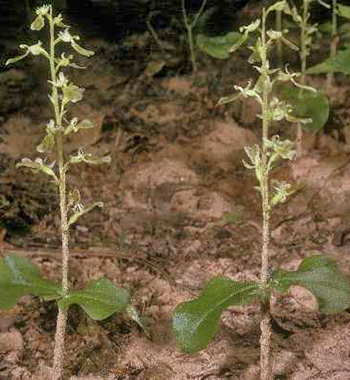
Goodyera oblongifolia, Western Rattlesnake Plantain
Goodyera pubescens, Downy Rattlesnake Plantain
Goodyera repens, Lesser Rattlesnake Plantain
Goodyera tesselata, Checkered Rattlesnake Plantain
Listera convallarioides, Broad-lipped Twayblade
Pinguicula vulgaris, the Common Butterwort
Platanthera clavellata, Small Green Wood Orchis
Primula farinosa, Mealy Primrose
Primula mistassinica, Dwarf Primrose
Saxifraga tricuspidata, Three-toothed Saxifrage
Viburnum edule, Squash berry.

Devil's Club: Eloise Butler's 1921 addition to her wild flower garden in Glenwood Park was this obscure plant which has a lengthly history. It is called “Devil’s Club” and from the Latin name of “Oplopanax horridus” you may gather it is somewhat formidable.
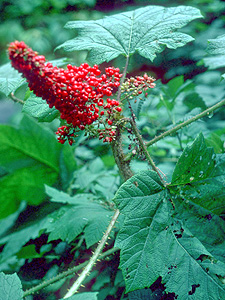
Martha Crone described it this way in 1955: “Devil’s Club or Devil’s Walking Stick is a member of the Ginseng Family. The densely prickly stems grow as tall as 13 feet. Both sides of the large leaves have scattered pickles. This plant often forms extensive dense thickets and because of the sharp prickles these are almost impenetrable. It grows abundantly in the forest of the pacific slope from Oregon to Alaska, and is also found about Lake Superior as well as in Japan. . A number of plants are thriving in the Wild Flower Garden.” (1)
Miss Butler’s log stated her plants came from Isle Royal. When Mrs. Crone planted more in 1935 her’s also came from Isle Royal as it grows nowhere in Minnesota. Martha’s friend Gertrude Cram supplied the Isle Royal plants with this note: “I hope you receive the Devil’s Club in sufficiently good condition to enable you to recognize it. The package was a flimsy one - there is never a box to be had here without reserving it weeks in advance - and I was not sure it would get through the mail. I put in two young plants in case you want to start a colony in your own yard or in the wild garden! It really is a handsome plant even if it is vicious.” (2)
The 1935 plants obviously survived a number of years but when they died out they were not replaced as when Ken Avery became Curator in 1959 he did not replace plants that were not native to the state, but then - there were also those words “impenetrable” and “vicious.”
NOTES:
(1) The Fringed Gentian™, Vol. 3 No. 1
(2). Letter from Rock Harbor Lodge, Isle Royal, marked 1935. One of several from that August, this one without a day of the month.