Mosquito Repellants in the Wildflower Garden
Plant extracts and experiments

To deter mosquitos you should avoid things that give off red and orange light, because mosquitos are attracted by those light frequencies in the presence of carbon dioxide. Flesh tones give off that color light and we exhale carbon dioxide, making humans prime targets for many disease transmitting mosquitos. (1)
Mosquito repellants can be natural or synthetic and most of us are familiar with the man-made versions. These were developed by trial and error. No one really knew why they worked. Witness Clinton Odell sitting in a chair out in Eloise Butler Wildflower Garden in the evening testing his companies repellant concoctions.(2) Nature had already solved that problem. So, what is it that makes natural plant repellants effective?
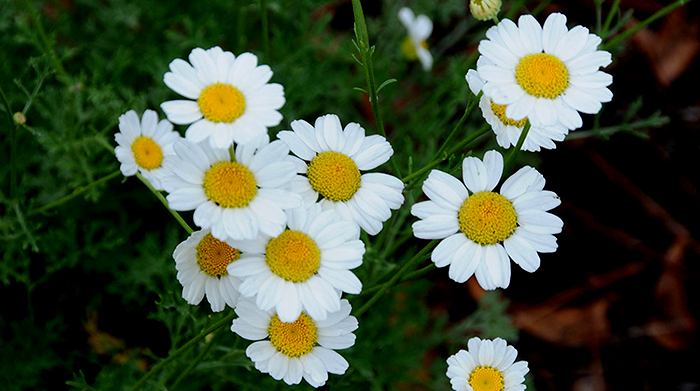
A recent study has uncovered the clue.(3) Mosquitos have over 100 receptors on their nerve cells. Those of what are called the “OR” type are attuned to warn the insect away. One of most potent plants that has been used as a repellant for thousands of years is the Dalmatian Chrysanthemum, aka Pyrethrum, (Tanacetum cinerariifolium). An extract of the dried flower gives a molecule called “pyrethrum” which has now been discovered to activate a certain nerve cell receptor (named OR31) which many disease bearing mosquitos have. When this receptor senses pyrethrum the mosquito flinches away.
Below: Dalmatian Chrysanthemum. Photo University of Mississippi Extension Service.
This discovery could lead to super enhanced repellants. More research is being done to determine which other plant molecules have a similar effect on certain receptors. Pyrethrum has a repellant effect on a number of insects but it does not harm pollinators, or other insects visiting the flowers as the active chemicals are locked in the seeds until dried.
There are two common plants in our local natural environment which are known to have repellant properties. One is another Tanacetum - Tansy (Tanacetum vulgare) and Lopseed, (Phryma leptostachya).
Historically, in the Wildflower Garden, mosquitos were always a problem. Eloise Butler kept her version of repellant on hand in the Garden back in the day when there wasn’t a Metropolitan Mosquito Control District to fight the critters. This was written in a local newspaper: The curator’s office is equipped with anti-mosquito fluid so that those who can stay away from the woods for fear of the over-enthusiastic mosquito, need have not fear. If the visitor’s epidermis is unusually thin, he can get a “face and hand wash” free and after the fluid has been applied the mosquito will break all aerial records getting away from him.
Martha Crone frequently noted how bad they were, not just at Eloise Butler's memorial ceremony in 1933 when Theodore Wirth complained about them, but especially in the years 1938 to 1941 when they were a plague. In 1953 she purchased a sprayer and within two years wrote that the mosquitos were under control. We do not know what she used for insecticide but when Clinton Odell had complained to Park Board Superintendent Charles Doell about the mosquitoes in 1949, Dowell wrote back that he knew the Garden had mosquito problems for many years but “Frankly, I am a bit afraid of the extensive use of DDT as yet,” and went on to list his concerns. We know about DDT now. One of the first uses of the Friends annual donation to Garden support for equipment was for a backpack mist sprayer for Gardener Ken Avery in 1965. We do not know what chemical he used either but in 1991 Gardener Cary George could still state that the mosquito hatch was the worst in 15 years.
NOTES:
1. Research study led by University of Washington neurobiologist Jeff Riffell, in Nature Communications. PDF abstract of study at this link.
2. Interview with Martha Crone, published Winter 1978, The Fringed Gentian™, Vol. 26 No. 1
3. Research study led by Duke University neurotoxicologist. PDF abstract of study at this link.