The Friends of the Wildflower Garden
Purple and Deadly
by Gary Bebeau
What do you call a plant that makes its own fertilizer? We say they are carnivorous. Most of these species exist in bogs and other moist areas where soils are acidic and deficient in nitrogen or phosphorous. The Sarraceniaceae family consists of three genera: Sarracenia, with 12 species; Darlingtonia, with one species; and Heliamphora, with some 23 species. These plants modify leaves into insect traps called ‘pitchers.’ We have only one species in Minnesota, the purple pitcher plant, Sarracenia purpurea var. purpurea.
Eloise Butler explained how the plant functions: “A fly seldom escapes from one of these leaf traps when she visits it for a sip of water. For, if she succeeds in crawling up the inner slippery surface, she will encounter a margin of stiff, downward pointing hairs that will hinder further progress. As the insects decay, they are absorbed. In this way the plants obtain the nitrogenous food … necessary for all plants... But what is novel about the insectivorous plants is that they capture living insects. They can thereby get a living from poorer soil and with feebler roots than can other plants. The flower also has a striking appearance. The calyx is dark red purple. The fiddle-shaped petals of rich wine color are folded over a genuine umbrella - the stigma of the pistil, which not only serves the usual purpose of pollination, but also keeps the pollen and nectar dry - an umbrella in use long before man thought of making one.” (1)
The infrequent bog trotter may be excused for not noticing the purple pitcher plant during the summer, fall, winter and early spring as the pitchers rise no more than six to eight inches from the bog level. It is only in late spring when they flower that they make quite a display. The remainder of the year just the ground hugging leaves remain. These over-winter, resuming their purpose in the spring. As the leaves mature, they display an assortment of mottled colors.
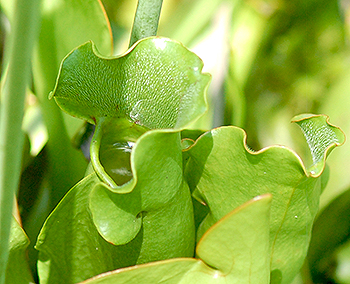
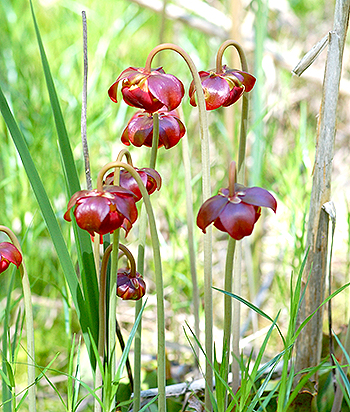
The purple pitcher plant has pitchers somewhat ‘S’ shaped, widest just above the middle, with the opening of the pitcher round to oval with a hood that partially covers it. Rainwater collects in the pitcher, with the fine downward pointing hairs around the upper part of the pitcher. The nectaries (an organ or part of a plant that secretes nectar) inside the pitcher attract the insects, but the larger ones such as bees, butterflies and moths can feed without being trapped.
The purple pitcher plant was never found in the current boundaries of the Wildflower Garden but was abundant just west in what is now called the Quaking Bog. When the Garden was officially created in 1907, the pitcher plant was the first species transplanted into the new Garden. Eloise planted them in 22 of her 26 years as Curator. Her successor, Martha Crone, transplanted many in 12 years of her 26-year tenure. The frequency of replanting is an indication that they do not like being moved and survival rates are poor for transplants.(2)
(1) Eloise Butler published this in an article in the Minneapolis Sunday Tribune, June 18, 1911.
(2) More details of this history and information and photos of the plant can be found the website at Purple Pitcher PLant.
Photos - Gary Bebeau. He is Friends Treasurer, Memorials Chair and Website Coordinator.
This article was originally published in The Fringed Gentian™ Vol. 67 No. 1