
These short articles are written to highlight the plants, history and lore of the Eloise Butler Wildflower Garden to past and contemporary events and may include personal commentary of the writer, not necessarily related to the Wildflower Garden. A web of present and past events.
March 2026
Articles
An Amphitheater for the Garden
Eloise Butler - Most common shrubs
An Amphitheater for the Garden
Last November we reported on the Minneapolis Park & Recreation Board’s (MPRB) “Eloise Butler Wildflower Garden Entrance Renovation Project,” which had its beginnings in the 2015 Theodore Wirth Regional Park Plan, with established guidance by community findings in 2022.
Last summer proposals were developed and submitted for public review. From that review MPRB staff developed a more definite plan.
As part of the public gathering space before entering the Garden, a section of the proposed design incorporates a naturalistic amphitheater on the hillside, with a group of curved benches and natural pavement. Pathways link to the main entrance path and the maintenance path. Native plants will be used in appropriate places and trees will be added as the area requires.
Below: A section of the Eloise Butler Wildflower Garden Entrance Renovation Project showing the proposed amphitheater area. Sketch - Minneapolis Park & Recreation Board.

An amphitheater has been considered for this area as far back as 2004 when the Friends were exploring a Garden feature in honor of former Gardener Ken Avery. When groups of school children visit this would be a quieting area to acquaint them with what is beyond the Garden Gate. In will undoubtedly have many uses.
Final design specifications are not yet fixed and a construction timeline is not yet available. More to come.
Update on Wisdom

We can’t let March go by without an update on Wisdom.
Who is Wisdom? Wisdom, the oldest known bird in the world, is a Laysan Albatross, band #Z333, that I have reported on for several years now. She returned to Midway atoll in November 2025, as did her latest mate, and is occupying the same nesting site she has used for decades. Wisdom is at least 75 years old, estimated to have laid 50 to 60 eggs and successfully fledged as many as 30 chicks. She was first banded in 1956 when she was, at a minimum, 5 years old. Watchers are waiting to see if an egg is produced this nesting season.
The perfect shade wildflower
One of our ten favorite spring wildflowers for a shady area is wild ginger (Asarum canadense).
The fuzzy mid-green foliage is lush and appears very early. Unlike the early ephemerals, wild ginger leaves last until frost, forming a tight bed of overlapping green leaves on plants that are not too particular as to the quality of the soils, so long as they are not subject to many hours of hot sun in the summer.

This makes wild ginger perfect for a shade garden that can be associated with other shade tolerant plants that retain summer leaves like wild geranium and many of the fern species.
If you look early enough, just as the leaves are elongating you will find on the stem beneath the leaf that unworldly looking burgundy flower that keeps away the evil eye, but quickly turns into a seed pod. Plants will form dense spreading clumps and transplant fairly easily.
Below: The flower of wild ginger and a selection of plants that could comprise a summer shade garden of native plants.


Our list of ten native plants for a shade garden.
Eloise Butler - the most common shrubs.

One hundred years ago Eloise Butler wrote that willows were the most abundant shrubs in the Wildflower Garden, with pussy willow (Salix discolor), slender willow (S. petiolaris) and Bebbs (S. bebbiana) the most abundant.
The wetland is not now as marshy, nor the water table as high, as it was in 1926 so it is not surprising that the willow population is much reduced. Red osier dogwood (Cornus sericea) is still around as is prickly ash (Zanthoxylum americanum), but smooth sumac and dwarf birch are now much less. Of round-leaved hawthorn, then so abundant, there is little to be seen.

About other shrubs, she stated that no other species was infrequent except for winterberry (Ilex verticillata). It was never prevalent in later years either and following a replanting in the 1950s, by 1987 only one plant remained and Gardener Cary George had to search to find the correct native species to replant. Several later re-plantings have kept them viable.
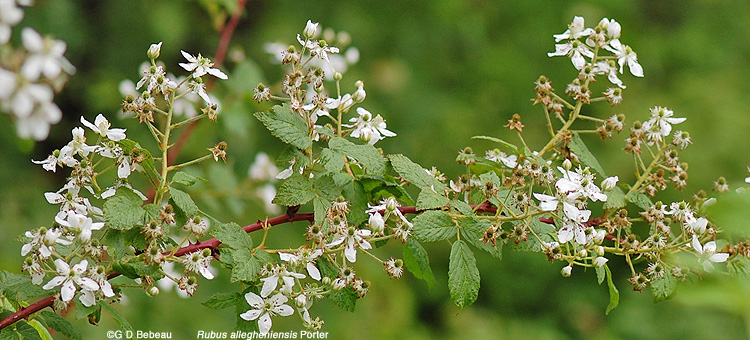
Needless to say, by the year 2000 the most prevalent shrub was common buckthorn, which today has been reduced to the least common - that is within the Garden fence. She referred to Blackberry (Rubus allegheniensis) as a “weed” that had to be grubbed out continually. That has not changed as the plant is very aggressive. One that had to be watched, Eloise said, so as not to become rampant was wild smooth rose (Rosa blanda) which makes one wonder why on earth she planted 400 of them in 1915. The Park Board nursery must have had a surplus.
Below: Allegheny Blackberry - one of those under-shrubs that Eloise called "weeds" that needed to be continually grubbed out.
Eloise Butler's 2026 article: Shrubs in the Wild Garden
Did you know . . .
Did you know that when Texas Hold’em poker is played with a short deck the probability of someone having a two-pair hand is higher than having a one-pair hand? And that a full-house is more likely than a flush? Unfortunately, these facts are probably not yet included in the upper level quant classes. (from latest research by computer scientist Christopher Williamson.)
Historical Photo
This might look like the aftermath of the recent snowstorm on March 15th but it was the aftermath of the storm on April 13-14, 1949 that dumped 9+ inches on the Wildflower Garden. Photo ©Friends of the Wildflower Garden from a Kodachrome by Martha Crone, April 14, 1949.
