
These short articles are written to highlight the plants, history and lore of the Eloise Butler Wildflower Garden to past and contemporary events and may include personal commentary of the writer, not necessarily related to the Wildflower Garden. A web of present and past events.
August 2026
Articles
Serviceberries - hundreds of gift exchanges
A cure for headaches, melancholy and possibly vertigo
Eloise Butler Council Ring
The Minneapolis Park & Recreation Board has designed the first phase of a renovation of the Garden's entrance. A centerpiece of the project is a new Council Ring—a welcoming gathering space where visitors can connect with one another, participate in educational programs, and begin their Garden experience.
In honor of Eloise Butler’s 175th birthday, the Friends of the Wildflower Garden are raising $175,000 by November 2026 to help fund the new Council Ring. Thanks to many generous supporters, we’ve already secured $100,000—help us raise the remaining $75,000 and give a lasting birthday gift that will welcome and inspire Garden visitors for generations to come.

For more than a century, visitors have found beauty, inspiration, learning, and connection in the Eloise Butler Wildflower Garden and Bird Sanctuary. Now, as we honor Eloise's legacy, we have a unique opportunity to invest in the Garden's future. As we celebrate Eloise Butler's 175th birthday, we invite you to be part of the Garden's next chapter. Together, we can ensure that this beloved sanctuary continues to inspire wonder, foster biodiversity, and connect people with nature for generations to come.
To make a gift or learn more, visit our council ring page or scan the QR code.

Serviceberries - hundreds of gift exchanges
Let’s discuss the serviceberries, the Amelanchiers, of which nine are found in Minnesota. They are also known as ‘Juneberries’ and all have either ‘serviceberry’ or ‘juneberry’ as part of their name.
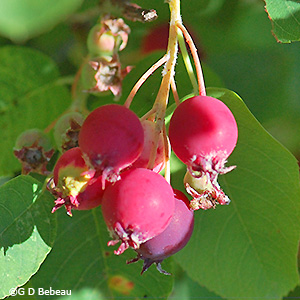
With 25 different species in North America you can imagine the difficulty in determining which Serviceberry or which Juneberry someone is talking about without getting to the scientific name. They bloom early and set fruit by late June, hence ‘Juneberry’ and in colonial times the fragrant flowers were brought in for church services, hence ‘Serviceberry’. Other attempts to define the name state a derivation from another genus of the Rose family, the Sorbus, but the link there is very unclear. They have an unusual leaf bud - the leaves are folded lengthwise down the middle in the buds (said to be 'conduplicate') rather than arranged in overlapping scales.
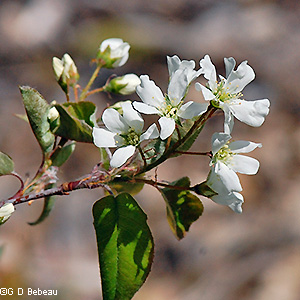
Several of the species are particularly well known. The Shadblow Serviceberry (Amelanchier canadensis), also known as the Canadian Serviceberry, which Eloise Butler originally planted in 1914 and former Gardener Cary George last planted in 1987. It has been called ‘Shadblow’ because on the East Coast, where the shrub is common, it flowers in June at the time of the running of the river herring - the Atlantic Shad. Other Serviceberries also use the name ‘shad blow’ but it properly belongs to this species. It is not native to Minnesota, we are west of its range, but it has been planted here many times. The Park Board nursery was growing them as early as 1914 when they came into the Wildflower Garden.
Serviceberry fruits are edible being juicy and sweetish. Early European settlers found them useful for puddings and pies and especially great for berry muffins. Merritt Fernald wrote “Few wild fruits of such excellent quality as the Serviceberries are less known to the modern American, although by the Indians and the early European explorers of the continent the berries were among the most esteemed of our native fruits.” (from Merritt Fernald's “Edible Wild Plants”)

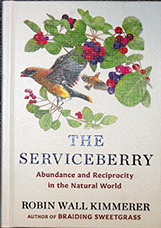
Robin Wall Kimmerer’s recent short book, following her successful Braiding Sweetgrass is simply titled The Serviceberry, in which she uses the serviceberry as a model to show us an economy based on reciprocity rather than accumulation. Her book uses the Saskatoon, or Western serviceberry (Amelanchier alnifolia) named for the city of Saskatoon in Saskatchewan as her example. It is native to Minnesota, but on the eastern edge of it’s range. The fruits are larger than the Shadblow.
Others to consider are the Downy Serviceberry, Amelanchier arborea, which is indigenous to the Wildflower Garden or the Allegheny or Smooth serviceberry, Amelanchier laevis, which is also native to the state. Some of the species remain shrubby, some can become small trees. Fall leaf color can be a nice yellow to yellowish-red to purplish red.
Below: The flower clusters of Saskatoon Serviceberry.

The swan house
Where do swans and ducks go in the wintertime? Years ago it was not where you may think.
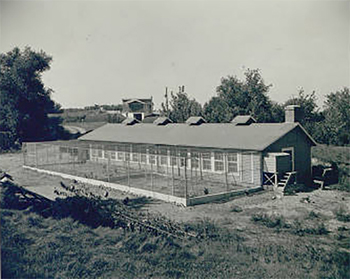
One group went to a comfortable warmed house right here in Minneapolis. These were the swans and ducks that populated summertime Minneapolis Parks in the 1930s and 1940s. In 1940 they wintered in a newly remodeled home, courtesy of the Park Board.
In the photo we see the newly remodeled duck and swan house in Glenwood Park in 1940. Located behind the park Keeper's house near France Ave and Glenwood Avenue, it was heated and had two pools to separate ducks and swans during the winter months. Comfty quarters. Photo Walter Dahlberg, Board of Park Commissioners.
A cure for headaches, melancholy and possibly vertigo
Today we look at two plants that are “good for them that are giddie in the head.” That was the wisdom of Gerard in 1597 and other herbalists and pharmacologists down to the current day.
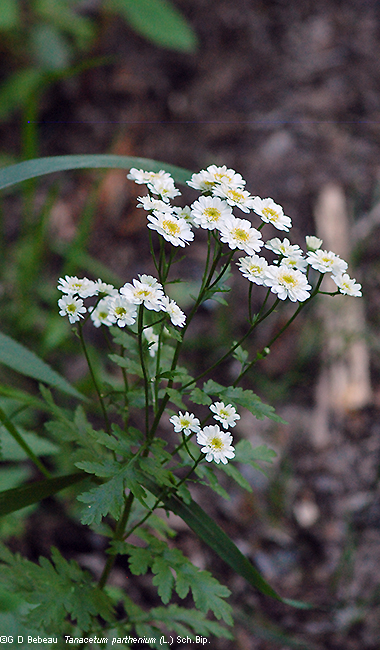
Gerard refers to the European plant feverfew (Tanacetum parthenium) and in North America we have American feverfew (Parthenium integrifolium) more commonly known as wild quinine. The plants share a part of the scientific name - parthenium - and they are both in the aster family but certainly do not resemble each other. In fact, the flowerheads of wild quinine are a bit odd for an aster. First only the outer ray florets are fertile (unlike other asters) and they number only 5 making them quite conspicuous on the flower head, whereas feverfew resembles many other flower heads in the aster family.
Gerard wrote in his Herball of 1597: "It is a great remedie against the diseases of the matrix; it procureth womens sickness with speed. . . Dioscorides also teacheth that is is profitablie applied to Saint Anthonies fire, to all inflammations, and hot swelligs, if it be laide unto both flowers and leaves. . . Feverfew dried and made into powder, and two drams of it taken with honie or sweete wine, purgeth by fiege melancholie and flegme; wherefore it is good for them that are giddie in the head, or which have the tuning called Vertigo, that is a swimming and turning in the head. Also it is good for such as be melancholike, sad, pensive, and without speech.
Need one say more. An research abstract on the plant is linked in our information notes.
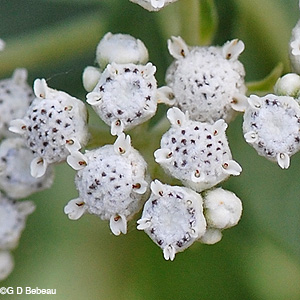
On our side of the globe the National Institute of Health has identified, a chemical obtained from Wild Quinine, as a potential anti-inflammatory active agent and has the potential for the treatment of cancer cachexia, a complex wasting syndrome. The name wild quinine comes from the use of the plant in place of medicinal quinine (the extract from the bark of the chincona tree used in treating malaria). The flowering tops make an infusion said to be equal to 20 grains of sulphate of quinine. That's equivalent to 4 standard 324mg quinine sulphate tablets available today.
Wild Quinine is quite rare here in Minnesota, but can be planted and grows well in prairie gardens. Feverfew is naturalized and found in many herb gardens but should only be planted carefully as it is very aggressive and small root sections will form new plants.
Many more details on these information pages:
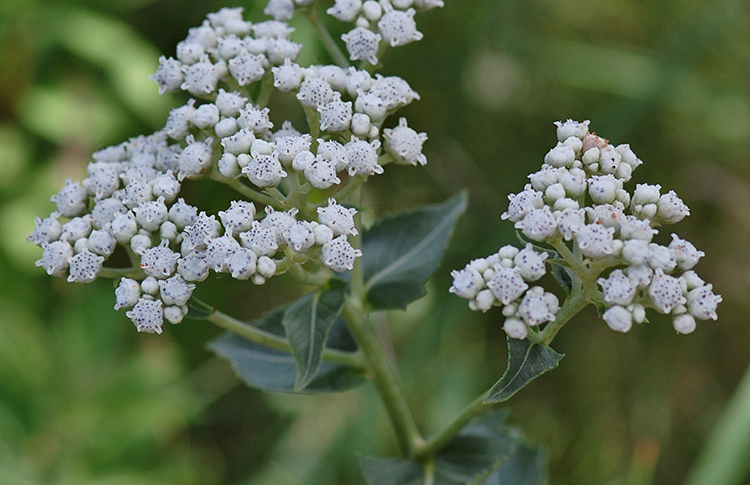
Below: The floral array of American feverfew, the wild quinine plant (Parthenium integrifolium).
Dragonfly in space

Yes, but not exactly a typical dragonfly. This one weighs about one ton and is about 13 feet long. And it is made of metal and has 8 rotors instead of flapping wings. Just what you need for exploring Titan, which is one of NASA’s latest adventures.
Looking at the design - which has been built - you certainly can see the dragonfly resemblance - just a bit exaggerated and less sleek. It’s eyes are radar, lidar and cameras. Energy from a small radioisotope thermoelectric generator. Targeted launch date is a year from now. Six years to Titan and then to work in an environment that is -180 degrees C and pressure 1.5 times earth. You can learn all about Dragonfly at https://science.nasa.gov/mission/dragonfly/
Historical Photo
Wild Cucumber (Echinocystis lobata) is indigenous to the Garden but now an ex-resident, disappearing sometime in the last half of the past century. Strange, as it is not uncommon around the metro area. Photo ©Friends of the Wildflower Garden from a Kodachrome by Martha Crone, August 17, 1952.

Not subscribed to our email?
Questions about Twigs and Branches?
Email the writer at this address.
Want to donate to support our mission for the Eloise Butler Wildflower Garden?
Link to donation page
Or use the QR code below.

©2026 Friends of the Wildflower Garden, Inc. "www.friendsofeloisebutler.org." Compilation, editing by G. D. Bebeau. Photos by G D Bebeau or as credited. 082026