

A PUBLICATION OF FRIENDS OF THE WILDFLOWER GARDEN, INC.
Summer 2025
Volume 73 No 2
Print version
Downloadable version of printed copy
Quick Links to this Issue
Feature articles
The confusing white-throated sparrow.
What's going on!
A busy spring at the Wildflower Garden.
Barn Swallows and Mud Pies
by Tammy Mercer

I grew up on a farm that had a big barn and several outbuildings filled with the mud nests of Barn swallows. All summer long, the air was filled with swooping swallows eating up the flying insects that might otherwise have made life miserable for us all. I loved watching their aerial maneuvers.

Photo - JJ Cadiz, CC BY-SA 3.0
While I was making mud pies, these industrious birds were making their nests out of mud. They will fly up to half a mile to find the right kind of mud. A nearby dredge would have been a good source for the swallows, plus there were often mud puddles where I found my pie ingredients. The swallows loaded their beaks with mud and built their nests one beak-full at a time.

While my mud pies often fell apart, the swallows knew how to incorporate grass stems and other plant fibers to help hold their structures together. They were also more particular about finding just the right consistency of mud because they could build their nests on a vertical surface without an underlying support. But where there was an underlying support available, such as ledges, beams, an old nest, or even an old mud wasp nest, they would surely make use of it.
Barn swallows are one of the most widely distributed bird species in the world, spanning much of North America and Eurasia. Before human structures became available, Barn swallows originally would have built their nests in caves, hollow trees, or on cliffs, where they might have some protection from the rain. Now they also have bridges, culverts, barns, and even the eaves of houses and other structures. Some cultures consider it good luck if a Barn swallow builds a nest on their house. (But not my grandma–too messy, she said.) Wirth Lake Barn swallows are happy to have the eaves of Wirth Beach House to protect their nests from the rain.

Photo Susanne Edele.
The nest cavity is cup-shaped and often lined with finer grasses, animal fur and feathers. There is usually an ample supply of animal fur and chicken feathers floating around farmyards. These are also great places to find enough flying insects to feed their broods.
Barn swallows rely primarily on flying insects for their diet all year round, so they must migrate south for the winter. But in spring they would come back to the farm where they could build a new nest on top of the old one. As for me, Grandma eventually taught me how to make fruit pies. But I will never tire of watching Barn swallows swooping through the air. ❖
Tammy Mercer is a MPRB naturalist at Eloise Butler Wildflower Garden and leads Saturday bird walks.
Photo at top of article by Laurie Wilson Neish, Macauley Library.
Slime Molds in the Garden
by Keygan S. S. McClellan
If you look closely, sometimes you can find shapeshifters in the Garden. Slime molds, with an important ecological role and a life cycle full of transformations, are one of our most unique forms of life.
[definitions at end of article] To find a slime mold, you can start by searching in moist, dark places in a temperate forest. The variety you’ll most often encounter are the plasmodial slime molds in class Myxogastria. While walking the Garden’s forested paths, I’ve regularly stumbled upon the scrambled egg or dog vomit slime mold (Fuligo septica), a conspicuous mass of bright yellow slime clinging to decaying stumps or wood mulch. Its fruiting body or sporocarp—a brownish, crust-like structure called an aethalium—can also be relatively easy to spot.


Finding other slime molds can be difficult. On the trails, I’ve carefully examined logs and stumps for out-of-place colors and textures, sometimes looking at pieces under the Micro-eye tool in the Martha Crone Visitor Shelter. In this way, I’ve glimpsed their strange world up close: a landscape of dark crevices crisscrossed by mycelial strands, roamed by tiny invertebrates like mites, proturans, slugs, and isopods and dotted with alien “trees” only millimeters tall; these “trees” are the spore-bearing sporangia of slime molds. The red raspberry slime mold (Tubifera ferruginosa) may appear in pillows of vibrant pink-red nubs; its sporocarp, a pseudoaethalium, is a massed structure made of many sporangia. The chocolate tube slime mold (Stemonitis splendens) can appear in small clusters of dark, purply-brown, hairy strands. The carnival candy slime mold (Arcyria denudata) may show up in bunches of fuzzy, pinkish, pill-shaped sporangia on thread-like stalks.
Below: Chocolate tube slime mold detail. Photo MPRB.

The slime molds we see are only half the story: much of their life cycle is microscopic. They begin life as spores ejected from sporocarps, which then bud into haploid cells. Each cell can swap between different physical forms depending on environmental conditions: a pliable “myxamoeba” in dryer environments, a tailed “myxoflagellate” which swims through wet environments with its flagella, and, in conditions of extreme dryness or food scarcity, a shelled “microcyst” which can remain dormant for a year or more. The cells feed like many cells do: engulfing smaller prey like bacteria, yeast cells, and fungal spores through a process called endocytosis.

Life as a microscopic cell comes to an end when the cell meets another cell of a compatible mating type, at which point the two cells fuse into one diploid zygote. The zygote begins to feed, and as it does, it grows … and grows. Unlike the multicellular zygote of a plant or animal, a slime mold does not divide into additional cells. Instead, the single cell balloons in size, with its nuclei dividing and becoming more numerous. In this enlarged state—sometimes reaching a foot or more across—the slime mold, now a plasmodium, seeks to voraciously continue its growth, using light and chemical cues to navigate. It scours the surfaces of dead wood and leaves for bacteria, fungal and plant spores, protists, molds, and particulate matter, engulfing all of it like the Blob from the 1958 film. This makes slime molds a key part of nutrient cycles in forests, as they consume decomposers and are in turn fed upon by invertebrates like springtails, nematodes, and rove, fungus, and slime mold beetles.
Eventually, another transformation grips the slime mold: the final phase of its life cycle. During fructification, the plasmodium transforms into a sporocarp, which can assume many shapes and colors depending on species (in addition to the aethalium, pseudoaethalium, and individual sporangia, there are also net-like structures called plasmodiocarps). The slime mold reshapes itself, its nuclei dividing to form haploid spores, which are released as the sporocarp dries. Spores are dispersed through different means, sometimes drifting on the wind, and, in some species, carried by fungus beetles in the Latridiidae family.
In addition to their unique lives, some slime molds have biological superpowers. Scientists have found slime molds hosting bacterial colonies that, because of the partnership, are capable of feats like fixing atmospheric nitrogen (like legumes). Some slime molds are known to produce antimicrobial agents, and others can bind heavy metals into inert forms. This latter property belongs to the yellow pigment fuligorubin A, which helps give the scrambled egg slime mold its bright color.
Although humble at first glance, slime molds lead dynamic lives full of transformation, hunger, and biochemical wonders. In the Garden, they play inconspicuous yet valuable roles in the cycle of decay, and when you see one, whether as a plasmodium or a sporocarp, remember that it is merely one of several shapes they can assume throughout their lives. ❖
Below: Chocolate tube slime mold on stump. Photo MPRB.

Definition of terms as they appear in the text.
•Plasmodium: an organism which is one massive, amoeba-like cell with many nuclei
•"Myxo" comes from the root "Myxa," an Ancient Greek word meaning "mucus".
•Proturan: a kind of tiny, eyeless, soil-dwelling arthropod related to insects
•Isopod: a kind of land-dwelling crustacean, known as "pill bugs," "wood lice," and "roly polies"
•Sporangia: a capsule containing spores
•Sporocarp: the spore-producing stage of a slime mold's life cycle; may be composed of many clustered sporangia
•Haploid: containing a single set of unpaired chromosomes
•Endocytosis: a process by which matter is enfolded into a cell membrane, which then pinches off into an isolated compartment for digestion inside the cell
•Mating type: the equivalent to sex in many microorganisms, fungi, and slime molds; there are often more than two mating types in a given species
•Diploid: containing two complete sets of chromosomes
•Protist: an organism that is not an animal, land plant, fungus, or bacterium; often microscopic and single-celled; historically grouped into the now-defunct Protista kingdom of life
Keygan S. S. McClellan is a naturalist at the Eloise Butler Wildflower Garden. Her article and the photos appear courtesy of the Minneapolis Park & Recreation Board.
The confusing white-throated sparrow
by Gary Bebeau

Was Audubon right or wrong in labeling the sexes of this bird on his drawing? Observers of this species of sparrow know that some individuals have bright black and white stripes on the head and others have more drab tan and grey stripes.
Most observers classify birds with bright flashy colors as male and those with drabber colors as female. That seems to work–but not always and not with the white-throated sparrow. It turns out that about half the birds with black and white stripes are female and half of those with tan and grey stripes are male. So, Audubon only had a 50-50 chance of being right.

This bird is the remarkable exception to the general rule. Though it has sometimes been called the bird with four sexes, there are actually only the standard two sexes, which are obscured by what goes on in their genes. Birds with one color-set of stripes will almost always choose mates from those with the other color-set of stripes. Short of examining a particular bird’s anatomy, close observation of the bird’s behavior can give clues to its sex. But first, what’s going on here?
Bird sex chromosomes are labeled Z and W (we humans have X and Y labels). However, the White-throated sparrow also can have a rearrangement called a “supergene”. Birds with the supergene will develop with white and black stripes–but may be male or female. Birds without the supergene will have tan and grey stripes, but may also be either male or female.


Does the supergene announce its presence in behavior? Yes, a patient observer may notice that a bird is more territorial and tends less to parental duties. That bird, be it male or female, usually has the supergene. White-striped birds that are female will have more masculine traits than expected in a female songbird, while tan and grey-striped males will have fewer masculine traits than expected in a male songbird. Likewise, white-striped females will have more aggressive tendencies than expected in a female.
So don’t be surprised if you hear a tan and grey-striped white-throat singing, and singing more strongly than a white-striped one. It’s most probably a male. ❖
Refs:
"Beyond XX and YY", Amanda Montanez, 2017
"The Bird that broke the binary", Donna Maney, 2025
Gary Bebeau is a Friends board member.
President's Greeting
Dear Friends,
This spring I discovered a Spring beauty, Claytonia virginica, which has long, narrow leaves and a half-inch flower blooming in my garden. I hadn’t planted it, but I was delighted to find it.
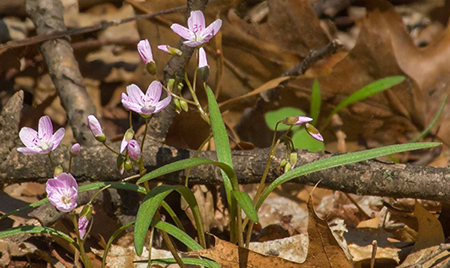
Spring beauty was last planted in the Eloise Butler Wildflower Garden in 2016 and it has only intermittently bloomed, but this spring it displayed a vigorous patch. The flowers were a distance from the path, so this half-inch blossom was best seen with binoculars.
Eloise Butler introduced Virginia spring beauty to the Garden on several occasions in the early years, starting in 1907, when on June 3rd she transplanted a clump sourced near the Lake Street Bridge in Minneapolis. Eloise Butler wrote in her 1911 newspaper article: “The spring beauty is local, but it brightens large patches of low woodlands, which it chooses for an abiding place. Spring beauty of Minneapolis is a low, slender plant with narrow leaves which come from a dark brown triangular tuber embedded in the earth. The flowers are dainty white bells striped with pink, and in masses thickly carpeting the earth are a joy to the eye.”
Virginia Spring Beauty which has narrow leaves.
Below left: Grouping - photo Bob Ambler. Right: flower detail - photo G D Bebeau.
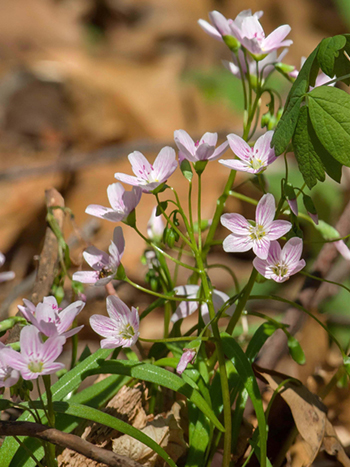
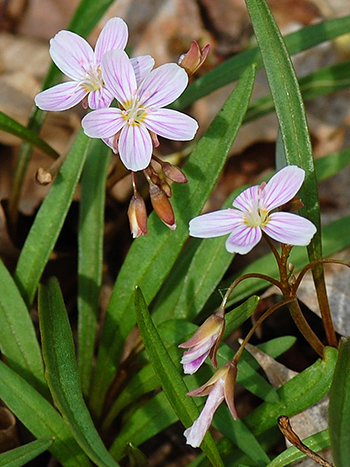
Eloise planted it six more times and planted Carolina spring beauty in 1912, but it was never included in the later census. Martha Crone, Cary George, and Susan Wilkins planted Spring beauty repeatedly. As with many spring ephemerals, dry spring weather and hot summers can wipe them out. Claytonia caroliniana blooms in the Arrowhead area near Lake Superior, while Claytonia virginica inhabits the east side of the state north of the metro area and in counties in the SE section south of the Metro.
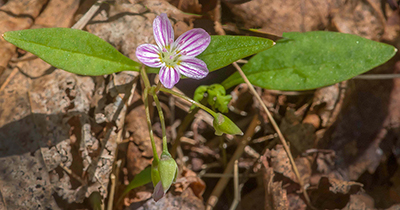
The author Phyllis Root’s book published seven years ago, Searching for Minnesota’s Native Wildflowers with beautiful photography by Kelly Povo, describes the Spring beauty as one of Minnesota’s true spring ephemerals. A true spring ephemeral blooms briefly and then vanishes completely, leaves and all, like the Garden’s three trout lilies.
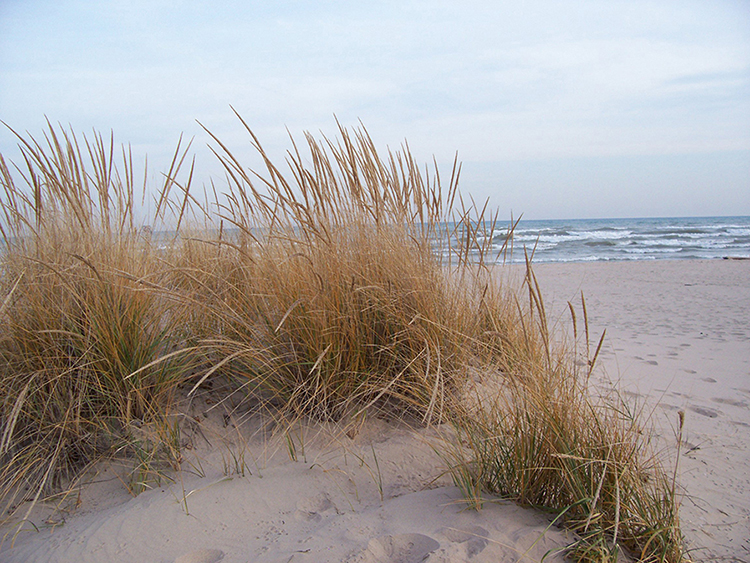
Root’s and Povo’s new book, Chasing Wildflowers, is now available. It presents 185 wildflowers in 11 microhabitats ranging from the North Shores to Minnesota’s wetlands, woodlands, rocky outcrops, floodplain forests and even road ditches. Only about 6% represent plants in the Eloise Butler Wildflower Garden. One year the authors drove over 12,000 miles chasing wildflowers, with their packed bug shirts, insect repellent and good rubber boots in the trunk! On my next trip to Duluth, my goal is to go to Pine Point, the only place in Minnesota to see the state-threatened American beach grass.
Spring has passed quickly and soon the Showy lady slippers will bloom and the Upland Meadow will turn purple with the False blue indigo. Search and Find your Favorite Wildflowers.❖
Jennifer Olson
Below: Jennifer's next plant quest: American Beach Grass, Ammophila breviligulata ssp breviligulata shown here on the Lake Michigan shoreline in Wisconsin. Photo - RoyalBroil CC BY-SA 3.0
Archive of previous President's Letters.
A Busy Spring Blossoms into a Bright Summer at the Wildflower Garden!
from Garden Curator Susan Wilkins
Each season at the Wildflower Garden brings its own beauty, blooming plants, and rhythms. The culminating effect of these elements coming together creates a rich and varied tapestry of experience. Each day is unique here, each season even more so.
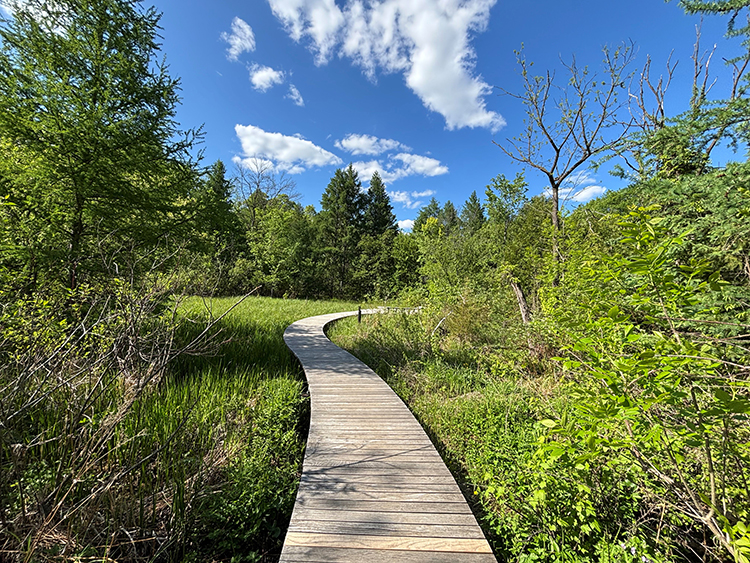
This past spring was a whirlwind of color, richness, and an abundance of engaged and enthusiastic visitors! In the first seven weeks of the season, from April 15-June 1, we have had a profusion of programs, activities, and volunteerism. A few highlights include:
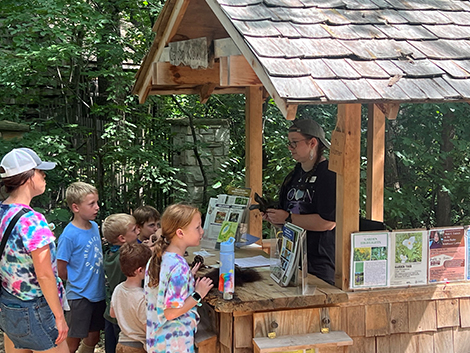
- 16,792 visitor engagements were noted by Garden volunteers and staff on the trails, at the Welcome Kiosk and in the Visitor Shelter. Think of all of these meaningful exchanges about the plants and birds of the Garden! At the Garden, we delight in nurturing the community’s love of nature one conversation at a time. Thank you, Garden docent volunteers and staff!
- 49 docent volunteers have been trained by the Garden Curator and have contributed 457.75 hours as they welcome and engage with visitors of all ages.
- 90 corporate volunteers gave 220 hours to spread wood shavings on the trails with Garden staff support.
- 30 youth and staff from Green Garden Bakery gave 45 hours and planted over 600 native plants at the Garden’s entrance meadow alongside the Natural Resources Specialist and Garden Curator.
- Over 500 native plants have been planted so far this season by the Natural Resources Specialist and Horticulture Support staff within the Garden, and over 1,850 more are being planted this June and throughout the summer. MPRB youth crews will join in the planting efforts this summer!
- 73 public tours and programs have been developed by Garden staff and offered by Garden Naturalists with 251 youth participants and 739 adult participants.
- 22 private group programs have been scheduled by the Garden Program Specialist and led by the Specialist and Garden Naturalists with 246 youth participants and 232 adult participants.
- In total, 1,468 people have participated in nature-focused tours and programs at the Garden so far this season! That’s 497 youth and 971 adults who have joined in the learning and fun!
- 60 Friends-supported land stewardship volunteers have contributed more than 580 hours in the Eloise Butler Wildflower Garden Volunteer Stewardship Area (warmly referred to as the Greater Eloise VSA) from January 1-June 1, 2025 with support from the Garden Curator.
The engagement work and educational opportunities provided here are possible thanks to the dedicated education staff and volunteers working at the Garden. Garden care is foundational to make this entire experience possible. A hearty thanks to all staff involved with hands-on garden management and care.
Thank you to all Garden staff working at the Garden this season including: Naturalists Jodi Gustafson, Ani Krause, Debbie Keyes, Katie Laux, Linette Maeder, Keygan McClellan, Tammy Mercer, Maria Montero, Lisset Olvera Chan, and Cheyanne Rose; Horticulture Support Staff Evva Jischke and Maggie Lile; Natural Resources Specialist Nicholas Purcell; and Garden Program Specialist Kimberly Ishkov.
I look forward to seeing you on the trails and at Garden programs this summer! ❖ Susan
Susan Wilkins is Curator of the Eloise Butler Wildflower Garden. Her article and the photos of the Garden are presented courtesy of the Minneapolis Park & Recreation Board.
From the Friends archives: The adventures of one 11 year old who visited the Garden with his mother:
Can a person whose head is filled with batting averages and dinosaur names find enjoyment here for three and a half hours? I needn’t have worried. He has walked the paths three or four times today, map in hand, my binoculars hanging around his neck, feeling quite independent. He comes back and tells me of his sightings: A pair of mallards making their way through the bog, a female cardinal flying across the path, a nuthatch giving its “ank-ank” call. He does not remark on flowers he has seen; flowers are of little interest to him. Birds are another matter. Their movements excite his imagination in ways that the silent blossoms cannot.”
Ann Kessen, 1989.

Read Susan's previous letters here.
News and Notes
FIPAG Activities:
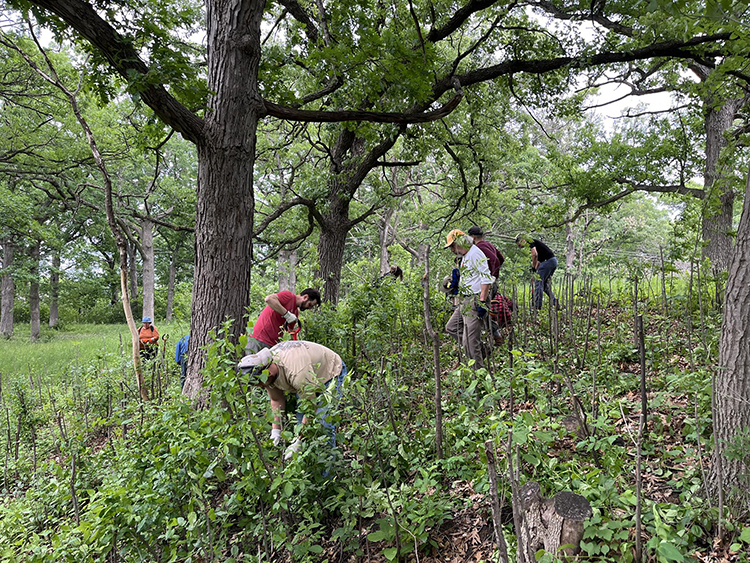
Above: No, these are not foragers, but FIPAG volunteers uprooting buckthorn plants and stripping new growth from previously cut buckthorn in Wirth Park. Photo - Jim Proctor.
The Friends Invasive Plant Action Group (FIPAG) has been busy every month this year working the Volunteer Stewardship Area east of the Wildflower Garden, clearing buckthorn, garlic mustard, planting, protecting the slopes with wattles and controlling new buckthorn growth.
The photo below shows the area tentatively named “Anwatin savanna”, near the pond with all the non-native woody plants removed or cutback for further treatment. Seeds of dozens of species that were spread in the fall and over the winter are germinating on the greening slopes. Sedges are flourishing.
A list of species seeded includes: Poverty oat grass, wood reed grass, gray wood sedge, beak grass, nodding fescue, little bluestem, side-oats grama, black-eyed Susan, shooting star, Canada milk-vetch, partridge pea, ground plum, white and purple prairie-clover, leadplant, prairie dropseed, junegrass, cream wild indigo, whorled milkweed, bottlebrush grass, and many more!

Notification of upcoming event
The date and time of our annual meeting and the name of our guest speaker will be announced in late August on our website, in Twigs & Branches and by email to those on our email list.
Notes For and About Our Donors and Volunteers
Annual financial Support: March 16 to June 30, 2025
Basic level:
Boehm, Deborah
Brunelle, Carolyn
Bystedt, Christi
Connors, Tom (new)
Godfrey, Otis and Ann
Harris, David and Pam
Kessler, Mel (new)
Levine, Sandra (new)
Lindh, Ruth
Lipschultz, Ellen
Marshall, Marcia
Meehan, Katherine
Montain, Andrew (new)
Nevin, Donald & Suzanne
Ruiz, Chris
Smudski, Karen
Spinosa, Ron
Benefactor level:
Hoch, Tom (new)
Jarvis, Bruce & Alison
Kornhaber, Susan
Lipschultz, Martin
Life level:
Streitz, Susan (new)
Sponsor level:
Arneson, Tom
Baker, Zachary
Battreall, Roger and Jayne Funk
Beitz, Toni
Kris Benson
Benson, Steve
Davis, Joy
Dean, Susan & Jeffrey
Korsmo-Kennon, Peggy
McClellan, Carla
Thompson, Joan & Drew Hamre
Annual Support information about:
1. Becoming an Annual Supporter of the Friends
2. Renewing your Annual Support
Can be found on our Website Donate & Support page.
Information on paying by check or by credit card is found there also.
For changes to your mailing address or email address, please use the annual support link on our contacts page or mail to: Friends of the Wild Flower Garden, Donor Support, P.O. Box 3793, Minneapolis, MN 55403-0793.
Other Donations and Memorials Received
Memorials/In-honor-of Received
March 16 to June 30, 2025
for Elizabeth Anderson from Heather Clark
for Dorothy Lucas & June Ortendahl from Joanne Ortendahl-Lucas
for Helen Wright King from Susan Kornhaber
for Tricia & Dale Thompson from Heather Henke
for Michele Wiegand from Melissa Hansen, Elizabeth Karlen, Debra Keyes
IHO Carolyn Brunelle from Christopher Brunelle
IHO Jennifer Swanson from William Sheffer
IHO Jennifer Olson and
Richard Sveum's 50th wedding anniversary from Susan Capiewski, Dana Hazel & Michael Vespasiano, Rebecca Martin, Amy Ryan
Other Donations Received - separate or an addition to annual support giving
March 16 to June 30, 2025
Benson, Kristin
Boehm, Deborah
Davis, Joy
Dean, Susan & Jeffrey
Dryden, Cherise
Furan, Jennifer
Godfrey, Otis & Ann
Haskell, Susan B. Levy
Jarvis, Bruce & Alison
Laux, Katie & Michael
Marshall, Marcia
McClellan, Carla
McNerney, Betsy & Donald Bell
Mendota Heights Garden Club
Nevin, David and Suzanne
Thompson, Joan & Drew Hamre
All 2025 donations and memorials
To make a donation go to our 'Donate & Support' page.
Other means of Support
Want to honor someone?
A gift in their honor can simply be a means of honoring a living person or some group
or
use this as an alternate type gift for a holiday, a birthday, an anniversary, etc. We will notify them of your gift and of how they will receive our newsletter and other communications for the year ahead. This will introduce them to the Friends and to the Garden. Use the mail-in form or the credit card link on our website 'Donate & Support' page.
Board of directors positions
The Friends Board of Directors can use your talents! We are an all-volunteer board that meets several time per year and if you have an interest in the Wildflower Garden and in helping support it and our mission of educating the public about the Garden and the natural world get more details by sending an email to the "requests" link on our contacts page.
You can also support our program by buying a plant identification book.
 Do you have our Plant Identification Guide? The 3rd edition has 1,950 photos of the 787 flowering plants, trees and the ferns of the Eloise Butler Wildflower Garden including many that are of historic interest. Four hundred of these books have been sold, so why not get yours!
From a buyer in New Hampshire: What a terrific collection of photos. I’m sure this guide will be a great compliment to other guides I have. From Minnesota: I love the book and will cherish it for many years to come. Credit card order or use the mail order form, both on our website here.

Sign up for Twigs & Branches: A monthly email update from the Friends containing news from the Garden and relevant MPRB projects, as well as access to website content featuring short articles from our Board and membership. These articles are written to highlight connections of the plants, history and lore of the Eloise Butler Wildflower Garden with different time frames or outside events.
If you already are signed up for our emails, you should be getting these. If you are not here's the link to the sign-up form. The form also allows you to sign up for our Fringed Gentian™ announcements and for the Friends Invasive Plant Action Group's emails.
The Fringed Gentian™
is published for supporters of the Friends and the Eloise Butler Wildflower Garden.
The Fringed Gentian Staff:
Colin Bartol, editor.
Betsy Kerr, copy editor.
Bob Ambler, staff photographer.
Karen Kopacz, fringed gentian illustration.
The Friends
Officers/Directors
Print version
Downloadable version of printed copy
Return to OR Learn more:
Spring note
I think of all the familiar wildflowers of America, from Queen Anne’s Lace to mullein that have crossed the Atlantic from Britain. Since it was mainly emigrants from western Europe that, bringing seed with them, developed North American agriculture, it is natural that a wide variety of weeds should have come with them. The total is more than 1000 species. In one list of weeds common in the state of New York, published in 1953, more than 40 percent were common also in England. An account of the important weeds on farms in Canada, issued by the Department of Agriculture, showed that more than 60 percent were introduced from Europe.
[Edwin Way Teale]
Below: Jerusalem Artichoke (Helianthus tuberosus), native Minnesota sunflower and indigenous at Eloise Butler. Photo G D Bebeau.

*Photo note: Photos with a “CC” credit are used for educational purposes under Creative Commons license. Learn about this at https://creativecommons.org/share-your-work/cclicenses/
©2025 Friends of the Wildflower Garden, Inc. www.friendsofeloisebutler.org.
Non-commercial reproduction of this material is allowed without prior permission but only with the acknowledgment to Friends of the Wildflower Garden, Inc., the author and the photographer.