These short articles are written to highlight the plants, history and lore of the Eloise Butler Wildflower Garden to past and contemporary events and may include personal commentary of the writer, not necessarily related to the Wildflower Garden. A web of present and past events.
June 2026
Articles
Eloise Butler Wildflower Garden Florilegium Exhibition
False Plants or is it just the name?
Praising the rescue of native plants - 1951 version
Eloise Butler Wildflower Garden Florilegium Exhibition

For a second time this year you will be able to see the drawings of plants in the Eloise Butler Wildflower Garden that were created for the Eloise Butler Wildflower Garden Florilegium Project which wrapped up in 2025 with 111 completed drawings. Coming this September 26th at the University of Minnesota’s Bell Museum will be an exhibit of the entire collection with the show ending on January 3, 2027. An exhibition catalogue will be available only at the opening reception - October 7, 2-3:30pm. The catalogue will illustrate one work by each of the artists involved in the Florilegium. The Friends will be sponsoring an event at the Bell during the exhibition. Details on that will be out later
Short's Aster
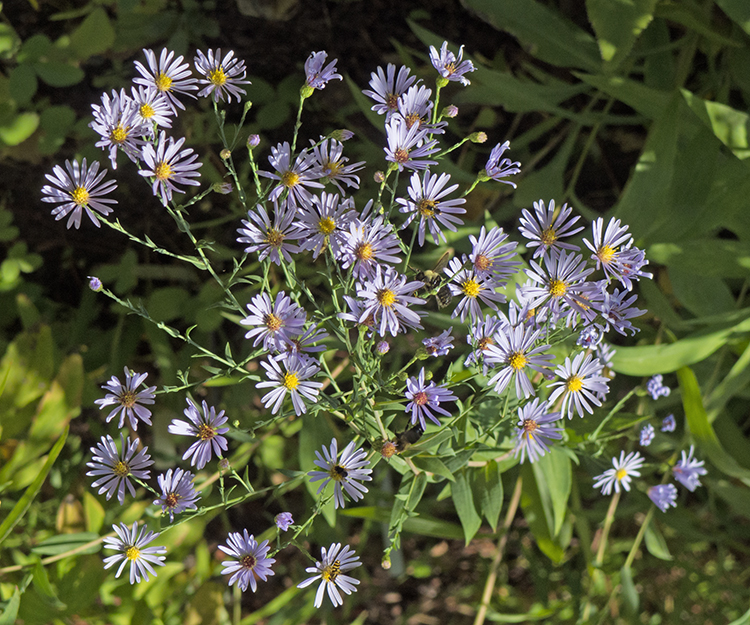
If you are a fan of blue asters you will like this one. Similar in color to the big-leaf, smooth blue and aromatic asters but different in style. This is a taller more robust branched plant with a floral array of ascending branching clusters of flowers, sometime so heavy the plant may lean over.
Short's aster (Symphyotrichum shortii) is similar to the big-leaf in that it prefers partial shade but unlike the big-leaf the root system is not such an aggressive spreader. Avoid full all day sun for best flowering. The root system will generate larger clumps of plants and self-seeding produces more.
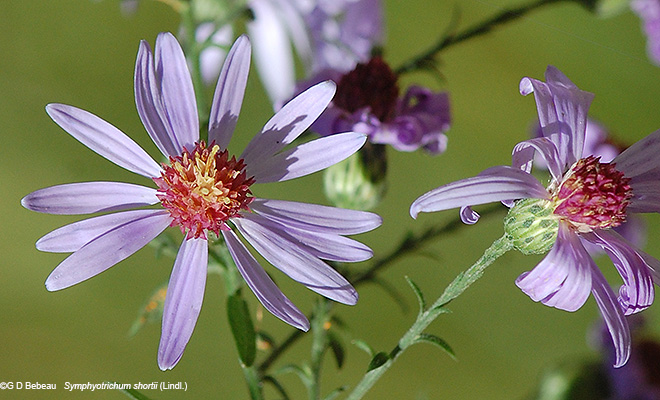
2026 is the 100th anniversary of the plants introduction to the Wildflower Garden. Eloise Butler found her original plants in Waseca MN on August 28th of that year. They were more plentiful in those years in the heart of the farm belt. Not so now. Today the DNR surveys find them only in Fillmore, Houston and Winona counties - the lesser farmed driftless area. More recently, some were planted in the Wildflower Garden in 2012.
The plant is named for Charles Wilkins Short, (1794-1863), American doctor and botanist, professor of medical botany, then Professor Emeritus of Materia Medica and Medical Botany at the University of Louisville, where he had helped establish the medical school. He discovered a number of plant species, was considered the most well-known botanist in his part of the country in the middle 1800s, wrote A Catalogue of the Native Phaenogamous Plants and Ferns of Kentucky, and maintained an extensive herbarium of over 15,000 plants.
Here is a link to our full information sheet on the plant.
False Plants or is it just the name?
In 1976, local poet Betty Bridgman raised an issue about an inappropriate use of words. At the annual meeting of The Friends she made a motion to remove the word ‘false’ from any Eloise Butler Wildflower Garden sign, as there were no ‘false’ plants, just different plants, and they all had alternate names.

Her motion was as follows:
I move that we request the change of every marker in the Garden which has the word "false" on it. No natural plant is false, and none imitates another plant, "False" is the word for phony or artificial, False flowers are plastic, paper, glass or wood. Every plant has a name that does not include the word "false", For instance, where our marker says False Solomon's Seal, it should say Solomon's Plume or Smilacina racemosa.
The motion passed after she agreed to bear the cost of new signs. She must have done so as minutes of the Annual Meeting one year later have this:
Ken (Avery, Garden curator) apologized to Mrs. Bridgman for not entirely completing the changing of markers of plants having “false” as part of their common names. He has done those whose botanical names he could find.
Yet, the use of the word “false” continues on. In the botanical sense it refers to a plant resembling in some fashion another plant or a New World version of a well known Old World plant. It was used to allude to what characteristics the “false” plant had and not just a sloppy cop-out to avoid thinking up a new name.
From just the Wildflower Garden census of plants, both current and historical, we can make a list of 33 plants with “false” plant names that are or have been in the Wildflower Garden. There are alternate appropriate names for some, but as Ken Avery noted, an alternate name avoiding "false" cannot be found. The use of the scientific name of course, avoids the issue.
Here are just a few from the list, especially those you may find in the Garden today.
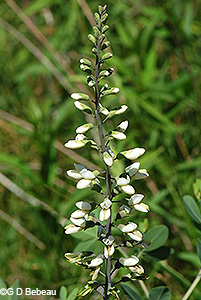
- False blue indigo (Baptisia australis), use blue wild indigo.
- False white indigo (Baptisia alba), use wild white indigo.
- False rue anemone or eastern false rue anemone (Enemion biternaum), no alternative name.
- False dragonhead (Physostegia virginiana), use obedient plant.
- False lily of the valley (Maianthemum canadense), use Canadian mayflower.
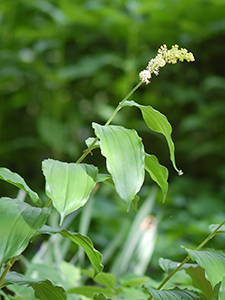
- False solomon seal or feathery false lily of the valley or false spikenard, (Maianthemum racemosum), no alternative.
- Starry false Solomon’s seal or starry false lily of the valley (Maianthemum stellatum), use starflower Solomon’s seal.
- False spleenwort or silvery false spleenwort (Deparia acrostichoides), use silvery glade fern or silvery spleenwort.
Below: A partial gallery of plants with "false" in the name.

Praising the rescue of native plants - 1951 version
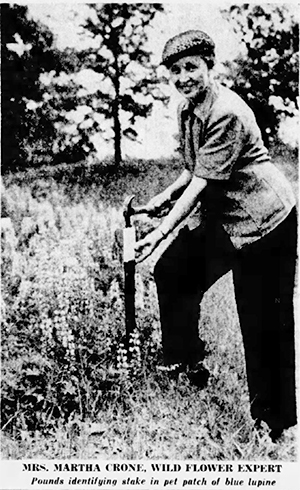
It used to be that people would dig up wildflowers and replant them where they chose, or they simply dug them up to "improve" the area. As society became more enlightened, they were dug to save them from extinction. In the history of the Wildflower Garden, both moving them and saving them are part of that history.
On June 10, 1951 The Minneapolis Tribune published an article titled “City Wild Flower Gardener Rescues Plants From Bulldozers.” It included this tidbit:
Mrs. Crone travels an average of 2,000 miles a month. Sometimes she digs up plants and sets them in moist moss and brings them back in the extra big trunk of her car. Often when she returns home late, she plants her wild flowers after dark. One whole bed of violets was planted one night by the light of the moon and a lantern propped in the path.
Several interesting other quotes come from the article. About the garden office:
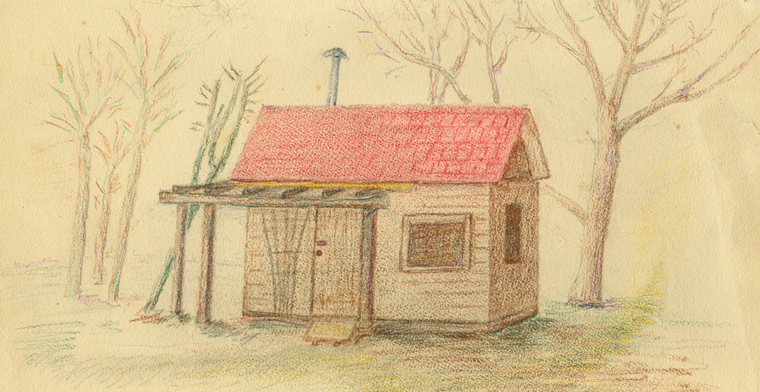
A tiny house stands in the center of the woods. In this ‘once upon a time’ atmosphere children might well expect the house to have a candy roof and be surrounded by gingerbread people. Actually it is not a fairy-tale hut, but one of the smallest office buildings in town - - possibly the only one without electricity or a telephone. There is even a bold clump of poison ivy, set back a-ways from the garden path. Mrs. Crone cares for it as tenderly as a wood violet. ‘It’s educational,’ she says.
Clinton Odell is also mentioned:
Clinton Odell, the “motivating spirit” of the garden, whose interest in wild flowers is as faithful as Mrs. Crone’s claims she has a special sixth sense for finding hidden flowers.
Image of the full Tribune article.
Below: A sketch of the "tiny house stands in the center of the woods" by a younger Clinton Odell.
A sedge worth considering - #3
This is the third of three sedges to consider for a place in any garden, particularly a native plant garden. In the past two months we covered Bottlebrush Sedge and Sprengel's Sedge.
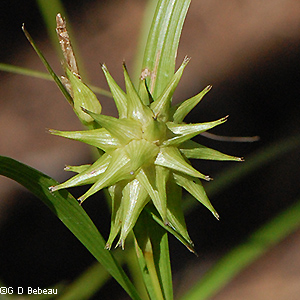
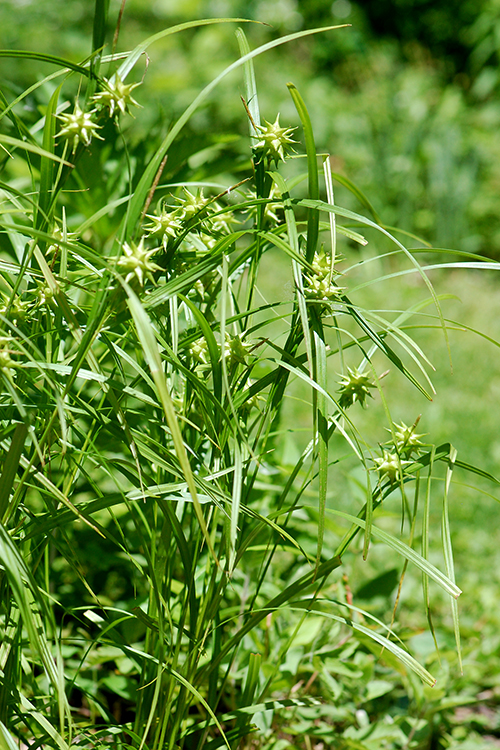
Our third sedge is Gray's sedge, Carex grayi. This native sedge prefers a mesic to moist woodland environment. The flowering stems (culms) grow 15 to 30 inches high, usually with multiple stems in a clump. It prefers partial shade, but will grow in full sun if the soil does not dry out. The stems are sturdy and don’t lodge presenting a pleasing appearance. The female spikes are ascending, densely crowded and densely flowered with 8 to 35 flowers forming a globular shape the size of which is seldom seen in sedge flowering spikes.
The plant is well behaved, no rhizomatous roots to form colonies. Instead the clump enlarges and can be separated for transplants. It also performs well in fresh and dry flower arrangements. Gray’s is one of over 150 sedges native to Minnesota but is somewhat rare and is on the MN DNR "Special Concern" plant list. Like the Short’s aster covered elsewhere this month, Gray’s Sedge is found primarily in the driftless area of Minnesota. Growing it will help preserve this valuable native sedge.
The species name, grayi, is an honorary for Asa Gray (1810-1888), American botanist, Professor of Natural History at Harvard.
Here is a link to our full information sheet on the plant.
Below: A Gray's sedge clump in early summer with multiple flowering stems.
Historical Photo
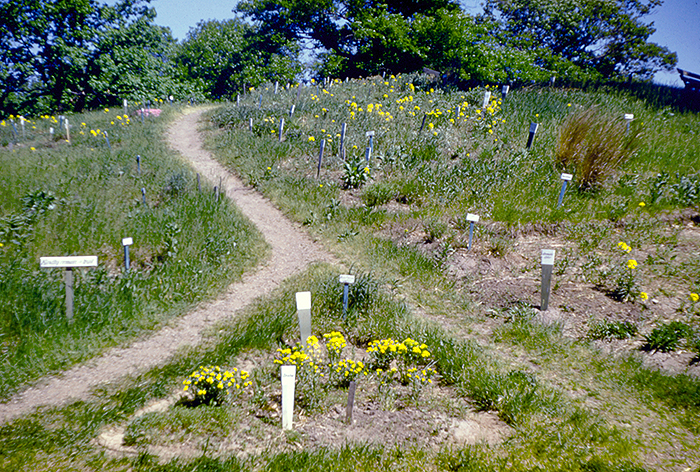
The upland garden center hillside in the continuing process of introducing native species following the areas addition to the Eloise Butler Wildflower Garden. Photo ©Friends of the Wildflower Garden from a Kodachrome by Martha Crone, June 5, 1950. The well-trod path on the left side is in the same position as today and pre-dated the addition of the area to the Garden.